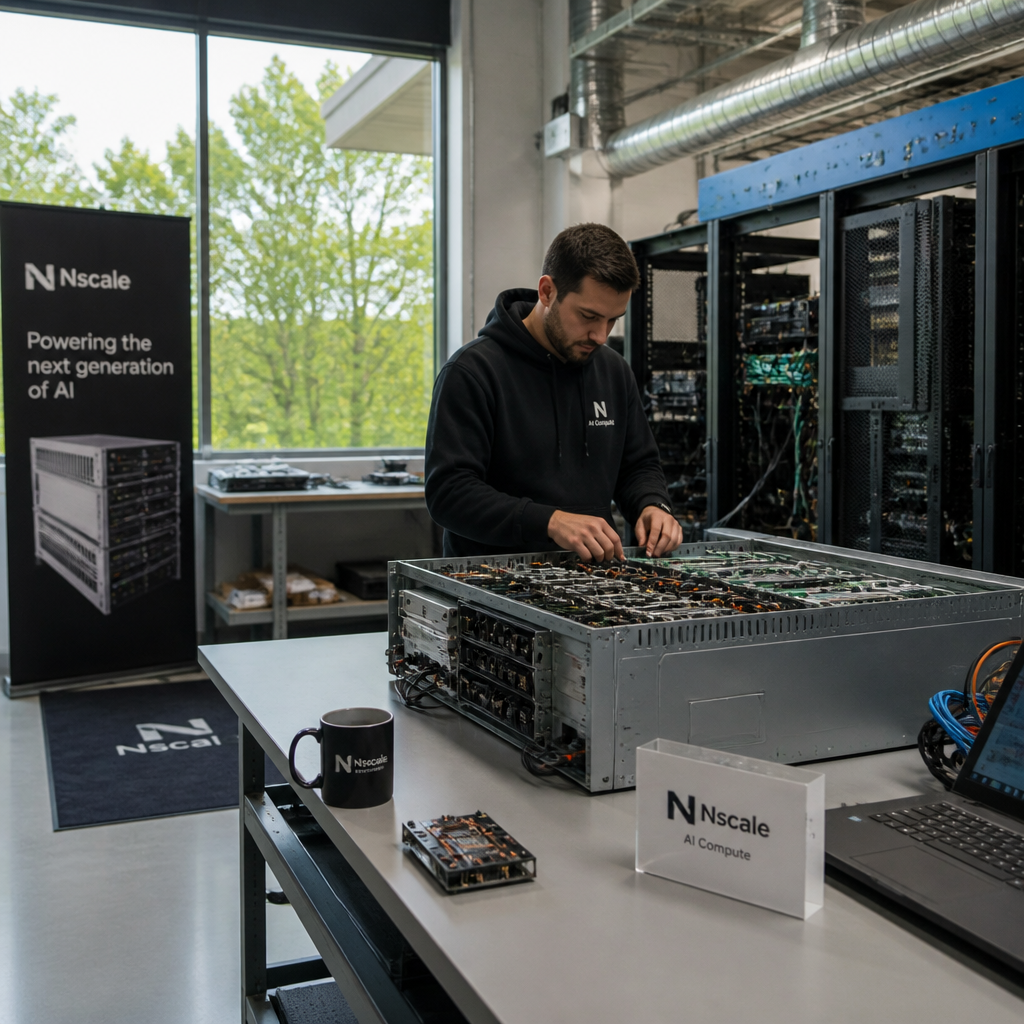
The global race to build and deploy artificial intelligence models has triggered an unprecedented capital expenditure cycle across the technology sector. In response to insatiable demand for high-performance compute clusters, specialized infrastructure provider Nscale has entered discussions to secure up to $3.5 billion in pre-IPO financing. The capital push, expected to blend equity and asset-backed debt structures, marks one of the most ambitious private funding rounds for an enterprise cloud platform to date, signaling both the immense costs and high-stakes financial maneuvers required to compete in the contemporary AI hardware landscape.
Originating with deep roots in high-density computing and high-efficiency energy infrastructure, Nscale has evolved rapidly into a prominent 'neocloud' operator. The firm designs, deploys, and manages scalable GPU environments tailored exclusively for foundation model builders, research institutes, and enterprise AI innovators who find themselves constrained by capacity bottlenecks at legacy hyperscalers.
The Neocloud Surge and the Race for Specialized Silicon
For decades, general-purpose cloud computing was dominated by a triumvirate of tech giants: Amazon Web Services, Microsoft Azure, and Google Cloud Platform. While these hyper-scale operators continue to command vast market share, their legacy architectures were engineered primarily for standard enterprise software-as-a-service (SaaS) applications, distributed microservices, and traditional relational databases. Generative AI fundamentally challenges these architectural assumptions, requiring massive parallel processing, extreme networking bandwidth via InfiniBand topologies, and continuous, ultra-dense power supply.
This structural misalignment created a significant market vacuum, catalyzing the ascent of specialized GPU cloud providers known as neoclouds. Nscale, alongside well-capitalized peers like CoreWeave and Lambda Labs, has positioned itself to bypass legacy cloud overhead by delivering bare-metal and containerized environments optimized purely for large-scale model training and low-latency inference.
- Ultra-High Density Compute: Purpose-built clusters housing tens of thousands of top-tier accelerators such as NVIDIA H100, H200, and next-generation Blackwell GB200 architectures.
- Custom Interconnect Fabrics: Low-latency, non-blocking network switching designed specifically to eliminate data transfer choke points during distributed gradient updates.
- Power Optimization: Direct access to renewable, cost-efficient energy supplies, decoupling high-compute operations from strained municipal energy grids.
"The economics of generative artificial intelligence are governed primarily by physics and balance sheets: acquiring access to stable electrical grids, securing cutting-edge silicon, and amortizing immense capital costs across long-term enterprise commitments."
Deconstructing the $3.5 Billion Pre-IPO Financing Package
Seeking $3.5 billion represents an audacious financial milestone for a privately held compute provider. Industry sources familiar with the negotiations indicate that the funding structure will likely leverage a sophisticated blend of growth equity and debt facilities secured against high-value physical assets, namely the GPU hardware and real estate assets underpinning Nscale's operations.
Debt financing backed by graphics processing units has emerged as a novel financial instrument over the past 24 months. Because high-end enterprise silicon acts as productive, revenue-generating capital machinery with reliable multi-year customer contracts, tier-one credit funds and sovereign wealth entities have shown willingness to underwrite structured debt against these assets. This approach allows Nscale to finance billions of dollars in silicon acquisitions while limiting catastrophic equity dilution for existing shareholders and employees prior to an eventual public market listing.
The pre-IPO designation of this capital raise suggests that Nscale's leadership is executing an aggressive medium-term roadmap toward a public debut. By staging a mega-round of this magnitude, the company aims to achieve the scale, operational reliability, and annual recurring revenue (ARR) profiles necessary to command premium institutional valuations when it formally lists on public equity markets.
The Operational Realities: Power, Cooling, and Infrastructure
While venture rounds in software typically fund engineering talent and marketing customer acquisition, infrastructure-layer AI financing is overwhelmingly consumed by capital expenditures. Deploying an institutional-grade AI datacenter demands far more than placing hardware into generic server racks; it requires a radical reengineering of thermodynamic and energy infrastructure.
Nscale has distinguished itself in part by aligning data center operations with direct, low-cost green energy, frequently utilizing Scandinavian and other international sites where hydro and geothermal power provide reliable baseload electricity. Modern AI training clusters operate at power densities exceeding 40 to 100 kilowatts per rack—far beyond the 5 to 10 kilowatt thresholds typical of standard enterprise cloud infrastructure. Meeting these physical thresholds requires direct-to-chip liquid cooling loops, advanced heat dissipation systems, and close proximity to reliable high-voltage electrical substations.
- Liquid-to-Air and Direct-to-Chip Cooling: Eliminating air cooling limitations to sustain continuous thermal efficiency and maximize silicon lifespan.
- Substation Interconnection: Bypassing multi-year grid queue backlogs by securing contracted, dedicated power agreements at the industrial generation level.
- Sustainable Sovereign Footprint: Providing European and international enterprises with localized data residency that complies with rigorous regulatory regimes, including the European Union AI Act and GDPR frameworks.
- Software Orchestration Layer: Developing proprietary virtualization layers that allow developers to extract maximum utilization rates out of allocated GPU cycles.
Navigating Asset Depreciation and Hyperscaler Retaliation
Despite the immense bullishness surrounding the artificial intelligence sector, Nscale's multi-billion-dollar pre-IPO ambition is not without formidable macroeconomic and technological risks. The enterprise compute model relies heavily on long-term client contracts to offset the rapid depreciation of semiconductor hardware.
Hardware lifecycles in the modern semiconductor sector are accelerating. With NVIDIA maintaining a rapid annual release cadence, infrastructure providers must balance the high acquisition costs of current-generation chips against the market's relentless demand for next-generation silicon. If an operator purchases tens of thousands of current chips at peak pricing, and rental prices collapse due to sudden market oversupply or generational obsolescence, debt-laden providers could face compressed gross margins.
Furthermore, incumbent hyperscalers are investing aggressively in their own internal silicon designs—including Google's TPUs, AWS's Trainium, and Microsoft's Maia accelerators—to reduce their reliance on third-party supply chains and improve workload unit economics. To maintain sustainable pricing power, independent providers like Nscale must deliver superior developer experience, higher cluster reliability, and flexible commercial contracts that hyperscalers are often unwilling to match.
The Long-Term Trajectory of the AI Infrastructure Market
Nscale's bid for $3.5 billion in pre-IPO financing serves as a stark barometer for the state of global technology investment. The compute layer has solidified its status as the foundational utility of the modern technological era—every bit as critical to the twenty-first century economy as telecommunications networks, electrical grids, and oil pipelines were to earlier industrial cycles.
Should Nscale successfully close the targeted financing round and transition smoothly to the public markets, it will cement its position among an elite tier of specialized operators powering the generative era. The transaction underscores an enduring truth: in the high-stakes realm of frontier artificial intelligence, software may captivate the public imagination, but victory ultimately belongs to those who control the underlying infrastructure, the energy, and the silicon.