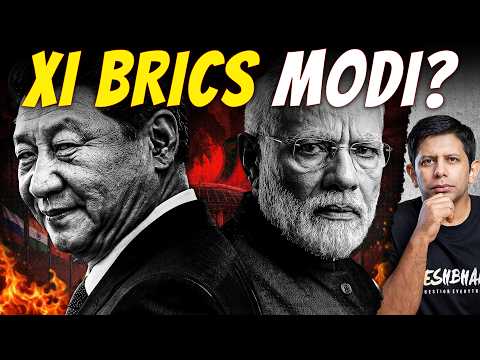
- The Setup: Modi and Xi shook hands at the Kazan BRICS summit, sparking massive global media chatter.
- The Skepticism: Veteran satirist and commentator Akash Banerjee urges viewers to look past the handshake and examine hard historical reality.
- The Motive: Beijing is likely managing its own economic slowdown rather than offering a genuine, lasting border settlement.
Here is what nobody tells you about high-stakes diplomacy: a single handshake in front of flashing cameras can wipe away four years of military standoff in the minds of hopeful headline-writers, but it changes precisely zero facts on the ground.
| Aspect | Traditional Approach | Modern Solution |
|---|---|---|
| Border Diplomacy | Secret bilateral talks | High-visibility multilateral summits |
| Economic Policy | Strict decoupling | Tactical selective engagement |
| Public Narrative | Permanent hostility | Carefully managed resets |
The Kazan Handshake: Real Breakthrough Or Optical Illusion?
Let's be candid: when Prime Minister Narendra Modi and President Xi Jinping met on the sidelines of the BRICS summit in Russia, the internet practically broke. Pundits rushed to declare a thaw in icy Himalayan relations. Troops had barely begun pulling back from disputed friction points in Eastern Ladakh when the commentary machine went into overdrive.
Enter Akash Banerjee. In his signature satirical yet deeply analytical style, Banerjee strips away the diplomatic varnish. He asks a blunt, uncomfortable question that mainstream news anchors often sidestep. Can New Delhi afford to trust a neighbor that has repeatedly rewritten border agreements whenever it suited their strategic calculus? History suggests a very short memory is a dangerous asset in South Asian foreign policy.
Why Beijing Decided To Smile Again
Geopolitics rarely operates on goodwill. Xi Jinping did not wake up feeling nostalgic for the 1950s Hindi-Chini Bhai-Bhai era. Let's look at the underlying pressure points. China faces a grinding property crisis, weakening domestic consumption, and relentless technological containment from Washington. A prolonged, hot or cold border conflict with India drains resources and pushes New Delhi further into the Western security architecture.
By offering a tactical pause, Beijing achieves multiple objectives at zero real cost. They keep Indian markets open for crucial manufacturing components while preventing New Delhi from becoming an unconditional frontline state in a US-led containment strategy. It is not a peace treaty; it is a tactical pivot.
Never measure diplomatic success by the warmth of a summit handshake. Always measure it by the speed of troop disengagement and the verification of restored patrolling rights on the ground.
The BRICS Playbook And India's Balancing Act
Akash Banerjee points out the inherent contradiction of India playing ball within a Beijing-dominated BRICS framework. On one hand, New Delhi champions a multipolar world order and fights for Global South leadership. On the other hand, it shares a heavily militarized, disputed 3,488-kilometer border with the bloc's undisputed heavy hitter.
- Multilateral Optics: BRICS provides a platform for alternative financial systems and anti-Western rhetoric.
- Bilateral Reality: Real-world security threats exist right at the Himalayan doorstep, completely unmitigated by multilateral declarations.
- Strategic Autonomy: India must constantly walk a tightrope between economic pragmatism and national defense.
Decoding The Satirical Lens: Why Banerjee Matters
Mainstream news often suffers from chronic state-whispering. They repeat press releases verbatim. Independent commentators like Akash Banerjee fill a vital gap by translating dry bureaucratic maneuvers into relatable, sharp critique. By utilizing humor, irony, and sharp data presentation, Banerjee forces ordinary citizens to look past the nationalist chest-thumping and ask tough questions about economic dependence and military preparedness.
Frequently Asked Questions
Did India and China completely resolve the border issue at BRICS?
Not even close. The agreement only restored patrolling rights in specific friction points like Demchok and Depsang. The broader structural dispute along the Line of Actual Control remains entirely unresolved.
Why does India continue to trade with China despite the tensions?
Pure economic necessity. Indian manufacturing relies heavily on active imports of active pharmaceutical ingredients, electronics components, and industrial machinery from China. Decoupling overnight would cause severe domestic inflation and factory shutdowns.