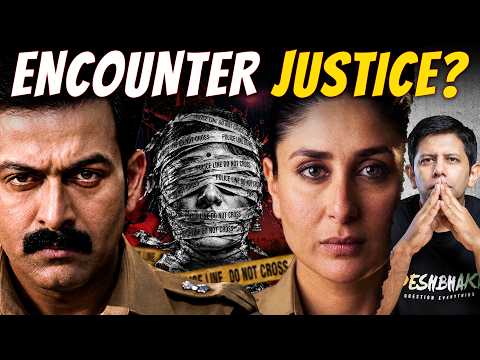
- Point 1: Daayra forces viewers to confront the terrifying normalisation of extrajudicial force in modern society.
- Point 2: Social commentator Akash Banerjee dissects how media narratives shape public tolerance for state violence.
- Point 3: The film asks an uncomfortable question: Are we trading constitutional rights for the illusion of instant safety?
Let us be candid: few things are as unsettling as watching due process get treated like an inconvenient speed bump. When a uniform decides who gets to breathe tomorrow and who gets erased today, we stop living in a democracy and start gambling with our survival.
When the Badge Becomes the Courthouse
Justice delayed is often justice denied. But justice bypassed entirely? That is simply tyranny wrapped in khaki. Akash Banerjee's razor-sharp breakdown of Daayra hits right at this raw nerve. The film does not ask you to sit comfortably in a plush theater seat. It drags you into the interrogation room, making you an unwilling accomplice to institutional decay.
- The blurring line between law enforcement and vigilante justice.
- How instant media trials prime the public to cheer for shortcuts.
- The systematic silencing of dissent disguised as public safety.
We have grown dangerously comfortable with quick fixes. If a suspect is dragged into the public square, our collective appetite for blood often overrides our demand for evidence. Daayra holds up an unforgiving mirror to this societal sickness.
The Illusion of Instant Safety
Speed is addictive. Society wants crimes solved by breakfast and punished by lunch. Cinematic tropes have trained us to love the rogue officer who breaks every rule to catch the bad guy. But reality does not work like a two-hour thriller. When rules disappear for them, they disappear for everyone else too.
Banerjee points out the deep irony in our collective applause. We trade our foundational rights for a temporary dopamine hit of retribution. Then, when the machinery of state power turns its sights on an ordinary citizen who simply asked the wrong question, the shock is entirely self-inflicted.
Rewriting the Rules of Engagement
What happens to accountability when power operates without oversight? The checks and balances designed to protect the vulnerable start looking like obstacles to people wearing badges. This is the central friction driving the narrative of Daayra.
| Aspect | Traditional Approach | Modern Solution |
|---|---|---|
| Guilt Determination | Courts and empirical evidence | Public sentiment and viral media clips |
| Accountability | Independent judicial oversight | Internal departmental reviews |
| Public Reaction | Skeptical and demanding proof | Eager for instant, violent retribution |
The table above tells a grim story. We are migrating away from tedious constitutional guarantees toward frictionless authoritarian impulses.
Never mistake state-sanctioned speed for actual justice. Whenever institutional shortcuts get normalized, ask yourself one simple question: Who protects you if you happen to stand on the wrong side of that shortcut tomorrow?
Can Satire and Cinema Save Us?
Can a movie or a sharp YouTube commentary actually alter the trajectory of a society hooked on instant outrage? Probably not overnight. Yet, ignoring the warning signs is a luxury we no longer possess. Banerjee's critique functions as an alarm bell in a room full of sleeping citizens.
- Art forces empathy where cold statistics fail to penetrate.
- Satire exposes the ridiculousness of unchecked systemic authority.
- Dialogue creates friction against the smooth rollout of totalitarian habits.
Frequently Asked Questions
What is the core premise of Daayra?
Daayra examines the dangerous erosion of judicial integrity and questions the societal appetite for extrajudicial action by law enforcement agencies.
Why is Akash Banerjee's commentary significant here?
Banerjee bridges complex political critique with mainstream digital media, translating heavy systemic failures into accessible, urgent conversations for everyday citizens.