Introduction to the Quantum Paradigm Shift
Quantum computing has evolved rapidly from theoretical physics papers into a tangible engineering discipline. For decades, the field was dominated by abstract mathematical formulations and academic proofs of concept. Today, however, hardware developers and software architects are confronting the brutal realities of decoherence, gate fidelity, and scalable infrastructure. This technical review examines the critical milestones that have brought us to the threshold of utilitarian quantum advantage, stripping away the hype to focus on architectural reality and practical applications.
At the heart of this transformation is the fundamental shift from classical binary processing to probabilistic quantum states. While classical bits operate in a definitive state of zero or one, qubits leverage superposition and entanglement. These quantum mechanical properties allow processors to evaluate vast configuration spaces simultaneously. Yet, harnessing these phenomena requires unprecedented levels of thermal control, precision microwave engineering, and sophisticated error-mitigation algorithms that push modern manufacturing to its absolute limits.
Hardware Architectures and the Scalability Bottleneck
The race to build a fault-tolerant quantum computer has spurred incredible innovation across multiple competing hardware modalities. Each platform presents distinct engineering advantages and formidable hurdles that researchers must systematically overcome.
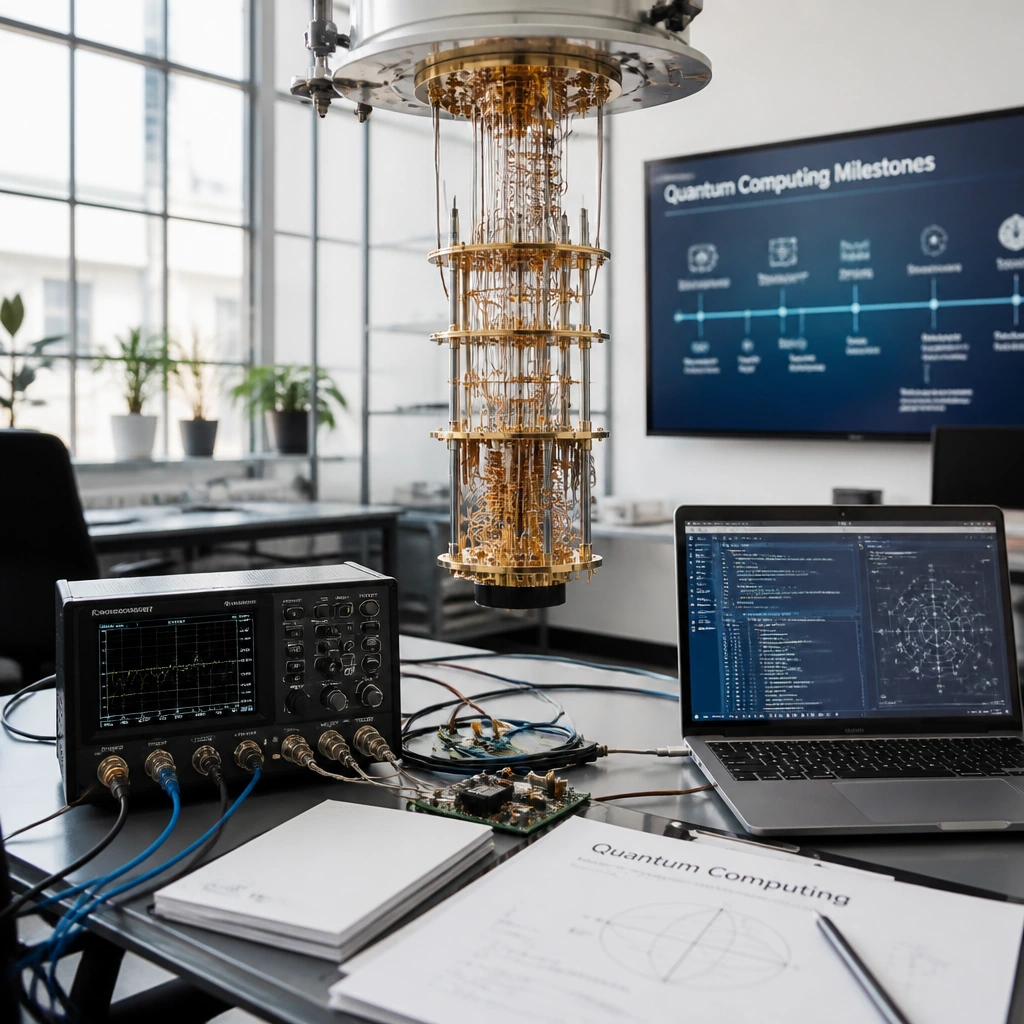
- Superconducting Circuits: Utilizing Josephson junctions cooled to millikelvin temperatures, this approach benefits from mature semiconductor fabrication techniques but suffers from short coherence times and complex wiring density issues.
- Trapped Ions: By suspending individual charged atoms in electromagnetic fields, trapped-ion systems achieve remarkable gate fidelities and all-to-all connectivity, though scaling the physical ion trap remains mechanically demanding.
- Neutral Atoms: Trapped in optical lattices via laser arrays, neutral atoms offer high scalability potential and dense qubit arrangements, though dynamic gate operations are still under intense optimization.
- Photonics: Operating at room temperature through optical pathways, photonic quantum computing eliminates cryogenic overhead, but probabilistic entangling gates introduce significant operational complexity.
Engineering scalable quantum hardware is not merely about adding more physical qubits; it requires a holistic redesign of the entire computing stack, from cryogenic control electronics to real-time classical processing engines.
Quantum Error Correction: The Path to Fault Tolerance
One of the most profound milestones in recent quantum computing history is the practical demonstration of quantum error correction (QEC). Unlike classical bits, which can be easily duplicated for redundancy, the no-cloning theorem prevents simple replication of quantum states. To protect fragile superposition states from environmental noise, physicists group multiple physical qubits into single logical qubits.
Recent experiments have proven that logical qubits can achieve longer coherence times than their constituent physical components, crossing a vital theoretical threshold known as the break-even point. Achieving fault tolerance demands surface codes and lattice surgery that require thousands of physical qubits per logical unit. Consequently, researchers are heavily investing in algorithmic error mitigation—techniques that suppress noise at the software level without the immediate hardware overhead of full fault tolerance.
Algorithmic Innovations and Near-Term Utility
As hardware matures, the software ecosystem is adapting to maximize the utility of Noisy Intermediate-Scale Quantum (NISQ) devices. Variational quantum algorithms, such as the Variational Quantum Eigensolver (VQE) and the Quantum Approximate Optimization Algorithm (QAOA), are designed to operate within the constraints of current noisy processors by hybridizing classical and quantum workflows.
These hybrid approaches are already showing immense promise in simulating complex molecular structures, optimizing global supply chains, and designing novel materials. By offloading specific, highly intractable computational bottlenecks to a quantum coprocessor, industries can extract value today while preparing for the arrival of fault-tolerant hardware architectures.
Practical Enterprise Applications Across Industries
The ultimate validation of quantum computing lies in its ability to solve problems that are intractable for the world's most powerful classical supercomputers. Several industries are actively positioning themselves to leverage these computational breakthroughs.
- Pharmaceuticals and Chemistry: Accelerating drug discovery by simulating molecular interactions and quantum chemistry at an atomic level with absolute precision.
- Finance and Risk Management: Revolutionizing portfolio optimization, derivative pricing, and fraud detection through advanced stochastic modeling and multi-variable analysis.
- Logistics and Transportation: Solving complex routing, scheduling, and traffic flow problems in real-time to drastically reduce operational inefficiencies.
- Materials Science: Discovering novel catalysts for carbon capture, high-temperature superconductors, and next-generation battery chemistries.
The transition from theoretical physics to enterprise integration represents a generational leap in computational capability, requiring organizations to build quantum readiness strategies today.
Conclusion and Future Outlook
The journey of quantum computing is moving past the era of isolated academic milestones into a structured engineering discipline characterized by rigorous benchmarking, error suppression, and practical deployment. While significant technical hurdles remain—particularly regarding cryogenic scaling and fault-tolerant architecture—the trajectory is unmistakable. Organizations that proactively monitor these developments, invest in quantum-safe cryptography, and experiment with hybrid algorithms will be uniquely positioned to lead the next era of technological advancement.