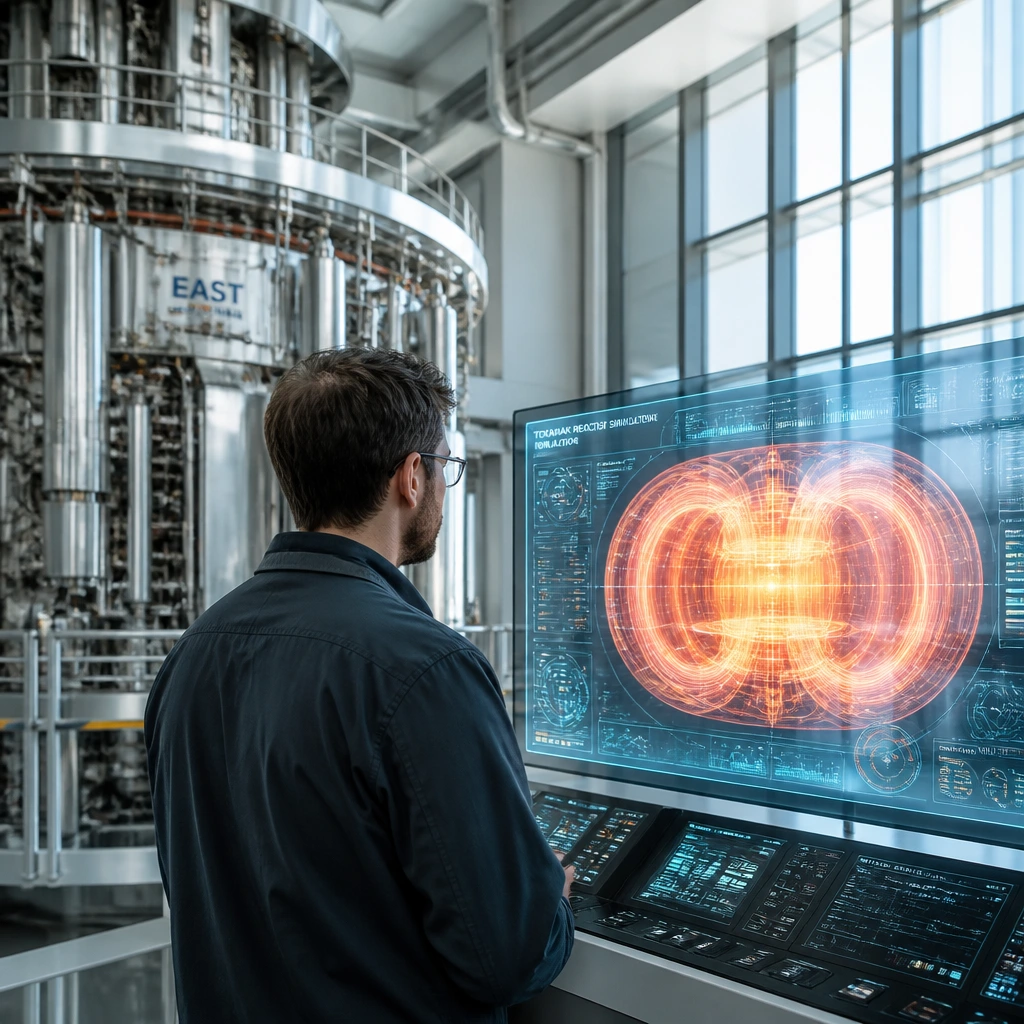
The Quest for Limitless Clean Energy
For decades, nuclear fusion has been heralded as the holy grail of energy production. By replicating the processes that power the sun, humanity could unlock a nearly limitless, safe, and carbon-free source of electricity. Unlike traditional nuclear fission, fusion does not produce long-lived radioactive waste, and there is no risk of catastrophic meltdown. However, mastering the physics of fusion has proven to be one of the most formidable engineering challenges in human history. The core obstacle lies in containing a superheated plasma—often reaching temperatures hotter than the sun's core—using powerful magnetic fields inside a reactor vessel called a tokamak.
Maintaining stability within this churning, chaotic soup of ions and electrons requires sub-millisecond precision. Traditional control systems, while remarkably sophisticated, often struggle to keep pace with the rapid, unpredictable instabilities that plague magnetic confinement. Enter a new wave of entrepreneurs: alumni from Google DeepMind. Having spent years pushing the boundaries of reinforcement learning and complex system optimization, these researchers are applying their expertise to the ultimate physical challenge. By merging state-of-the-art artificial intelligence with advanced plasma physics, they are building the digital tools required to make commercial fusion energy a reality for the modern electrical grid.
The Intersection of AI and Plasma Physics
The journey from theoretical physics to grid-ready power plants requires bridging a massive computational gap. At Google DeepMind, researchers famously demonstrated how reinforcement learning could control the magnetic coils of a tokamak reactor at the Swiss Plasma Center. This breakthrough proved that neural networks could autonomously learn complex control policies to shape and stabilize plasma far better than manually tuned algorithms. Now, former DeepMind scientists are commercializing these methodologies, developing software platforms designed to integrate seamlessly with both legacy and next-generation fusion devices.
These new AI tools operate on multiple fronts:
- Real-Time Stabilization: Utilizing deep reinforcement learning to predict and suppress plasma instabilities milliseconds before they breach containment walls.
- Reactor Design Optimization: Running massive virtual simulations to test novel magnetic field geometries without the immense cost of physical trial and error.
- Operational Efficiency: Streamlining the data pipelines from thousands of microscopic sensors to give operators unprecedented visibility into the reactor core.
- Predictive Maintenance: Anticipating hardware wear and thermal stress on reactor components to minimize costly facility downtime.
Translating Research into Grid-Scale Realities
Building algorithms in a tech laboratory is vastly different from running a commercial power station tied to a national grid. Fusion startups founded by DeepMind alumni are acutely aware of this operational chasm. They are not merely writing code; they are forging deep partnerships with private fusion companies and national laboratories to deploy their software directly onto physical hardware. This symbiotic relationship allows the AI models to train on unprecedented volumes of empirical data, drastically shortening the R&D feedback loop.
"The transition from pure artificial intelligence research to heavy industrial application is where the true test of modern engineering lies. By arming fusion scientists with intelligent control systems, we are shaving decades off the timeline to commercial viability."
As these software suites mature, they act as a force multiplier for the entire fusion sector. Instead of every reactor design team reinventing the wheel regarding plasma control, standardized AI frameworks can share generalized learnings across different reactor topologies—whether spherical tokamaks, stellarators, or magnetic mirror configurations. This collaborative digital ecosystem is essential for scaling the industry fast enough to meet aggressive global climate targets.
Overcoming Hardware and Computational Bottlenecks
Despite the immense promise of machine learning, bridging the gap between digital simulation and the harsh reality of a fusion reactor presents steep hurdles. Plasma environments subject sensors to extreme heat, radiation, and electromagnetic interference, often leading to noisy or degraded data inputs. AI models must be robust enough to make life-or-death control decisions even when operating with incomplete or corrupted telemetry.
Furthermore, the sheer computational load of running high-fidelity magnetohydrodynamic simulations alongside real-time reinforcement learning agents requires specialized hardware infrastructure. DeepMind alumni are leveraging custom accelerators, edge computing, and distributed cloud architectures to ensure their software can execute control decisions within microseconds. Overcoming these hardware bottlenecks is critical; a delay of even a single millisecond can cause plasma to strike the reactor wall, terminating the reaction and damaging physical components.
The Future of Global Energy Infrastructure
The ultimate metric of success for these DeepMind-spawned ventures is not just publishing groundbreaking papers in scientific journals, but delivering reliable electrons to the electrical grid. As coal and natural gas plants are steadily retired, grid operators face mounting pressure to secure baseload power sources that are independent of weather conditions. Wind and solar are vital, but they require massive battery storage or backup generation to maintain grid stability. Fusion power, enhanced by autonomous AI control systems, promises to provide continuous, high-density clean energy that can plug directly into existing transmission infrastructure.
Looking ahead, the convergence of artificial intelligence and nuclear fusion represents a triumph of cross-disciplinary innovation. By translating the algorithmic breakthroughs of computer science into the tangible physics of plasma confinement, a new generation of tech pioneers is redefining what is possible. The tools being forged today by these visionary alumni will soon power the grids of tomorrow, marking a monumental turning point in human technological history.