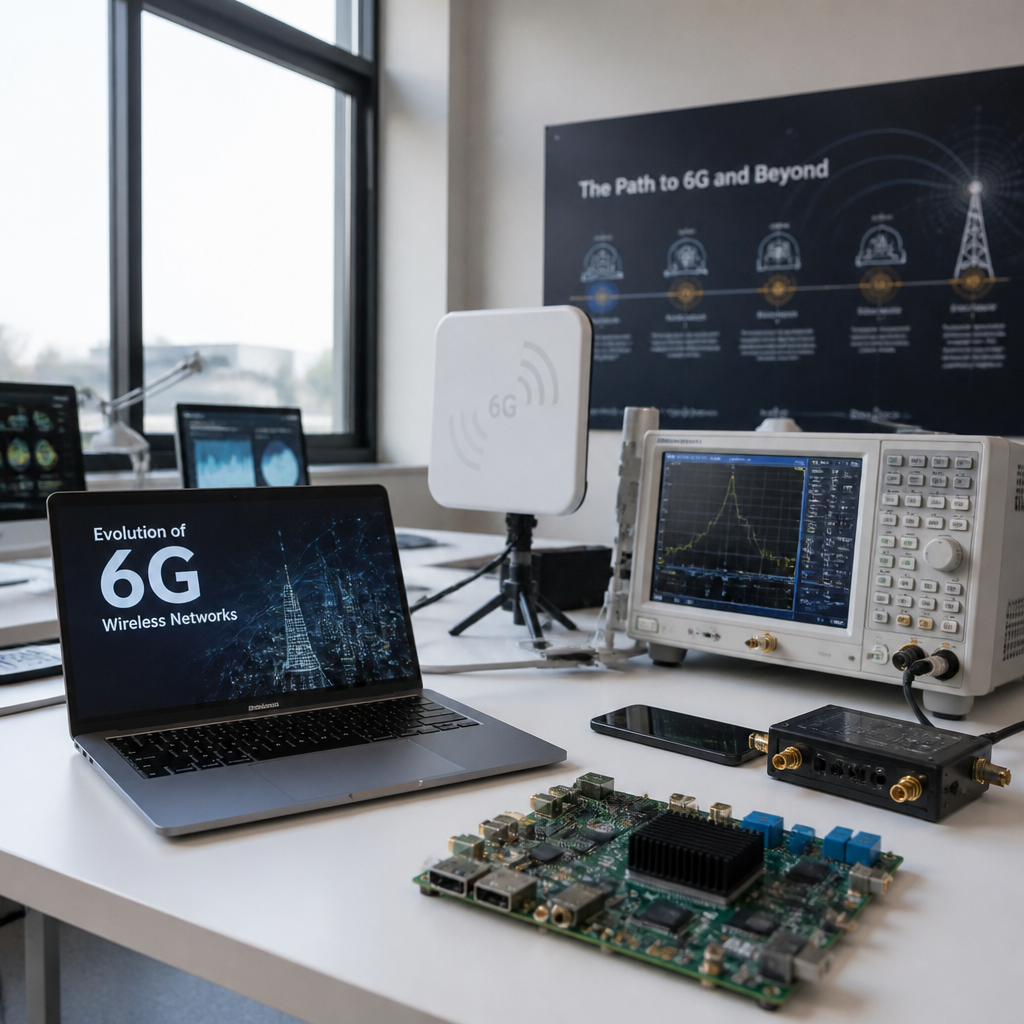
Introduction to the 6G Paradigm Shift
As the rollout of 5G networks matures globally, researchers, systems architects, and industry leaders are already setting their sights on the next frontier: sixth-generation (6G) wireless networks. While 5G fundamentally transformed mobile broadband by delivering unprecedented speeds and low latencies, 6G is poised to redefine the very fabric of human-machine interaction and global infrastructure. Telecommunications is no longer solely about connecting people to the internet; it is evolving into a pervasive nervous system for the planet, seamlessly blending the physical, digital, and biological realms.
For engineers and executives alike, understanding the trajectory of 6G requires looking beyond incremental improvements. We are entering an era defined by terahertz (THz) communications, artificial intelligence-native air interfaces, and quantum-secured architectures. Navigating this complex transition demands proactive strategic planning, robust research and development, and a deep appreciation for the multidisciplinary convergence driving tomorrow's connectivity.
Core Technological Enablers of 6G
The realization of 6G networks depends on overcoming formidable physics and engineering challenges. Chief among these is the transition from millimeter-wave frequencies to the Terahertz band, spanning from 100 GHz to 10 THz. This massive influx of available spectrum will unlock theoretical peak data rates scaling up to one terabit per second, driving latency down to sub-millisecond levels. However, higher frequencies present severe propagation hurdles, requiring radical advancements in antenna design and signal processing.
- Terahertz (THz) Communications: Utilizing ultra-high frequencies to enable massive data throughput and instantaneous downloads.
- AI-Native Air Interfaces: Integrating machine learning directly into the physical layer to optimize resource allocation dynamically.
- Reconfigurable Intelligent Surfaces (RIS): Deploying smart, programmable metamaterial surfaces to manipulate radio waves and eliminate dead zones.
- Joint Communication and Sensing (JCAS): Utilizing wireless signals simultaneously for data transmission and high-resolution environmental radar sensing.
Artificial Intelligence at the Core
Unlike previous generations where AI was applied as an overlay to manage network operations, 6G is architected from the ground up to be natively intelligent. Autonomous network management will become mandatory as the sheer density of connected devices and data streams overwhelms human operational capacity. Machine learning algorithms will predict traffic patterns, self-heal network disruptions, and dynamically allocate spectrum slices in real time.
AI is not merely a tool for optimization within 6G; it is the fundamental operating system of the network, enabling autonomous decision-making at the extreme edge.
Furthermore, federated learning will play a crucial role in maintaining user privacy while continuously training global models. Devices will learn locally from user interactions and environmental data, sharing only abstract model updates rather than raw information. This decentralized approach ensures scalability and resilience, protecting critical infrastructure against sophisticated cyber threats.
Implications for Global Industry Leaders and Engineers
The transition to 6G carries profound strategic implications for business leaders and technical innovators across sectors such as healthcare, automotive, manufacturing, and smart cities. Leaders must recognize that 6G will act as a foundational catalyst for immersive extended reality (XR), holographic telepresence, and fully autonomous industrial swarms. Capital allocation strategies must begin shifting toward research in advanced photonics, metamaterials, and quantum cryptography.
For systems engineers, the mandate is clear: master multidisciplinary competencies. The traditional boundaries separating telecommunications, computer science, materials engineering, and data analytics are dissolving. Designing the next generation of infrastructure requires holistic thinking, where hardware constraints are solved through algorithmic ingenuity, and software architectures are deeply harmonized with physical RF limitations.
Pathways to Standardization and Commercialization
As the global telecommunications community moves toward the anticipated commercialization of 6G around 2030, collaboration across international standards bodies, academic institutions, and private enterprises is critical. Avoiding fragmentation and ensuring global interoperability will determine whether 6G fulfills its promise of ubiquitous, seamless connectivity. Regulatory frameworks must also evolve to support dynamic spectrum sharing, cross-border data governance, and rigorous security standards.
In conclusion, the evolution of 6G wireless networks represents much more than a technological upgrade—it is a generational leap in global connectivity. By understanding the underlying physics, embracing AI-native frameworks, and aligning strategic investments today, engineers and business leaders can position themselves at the forefront of the next telecommunications revolution.