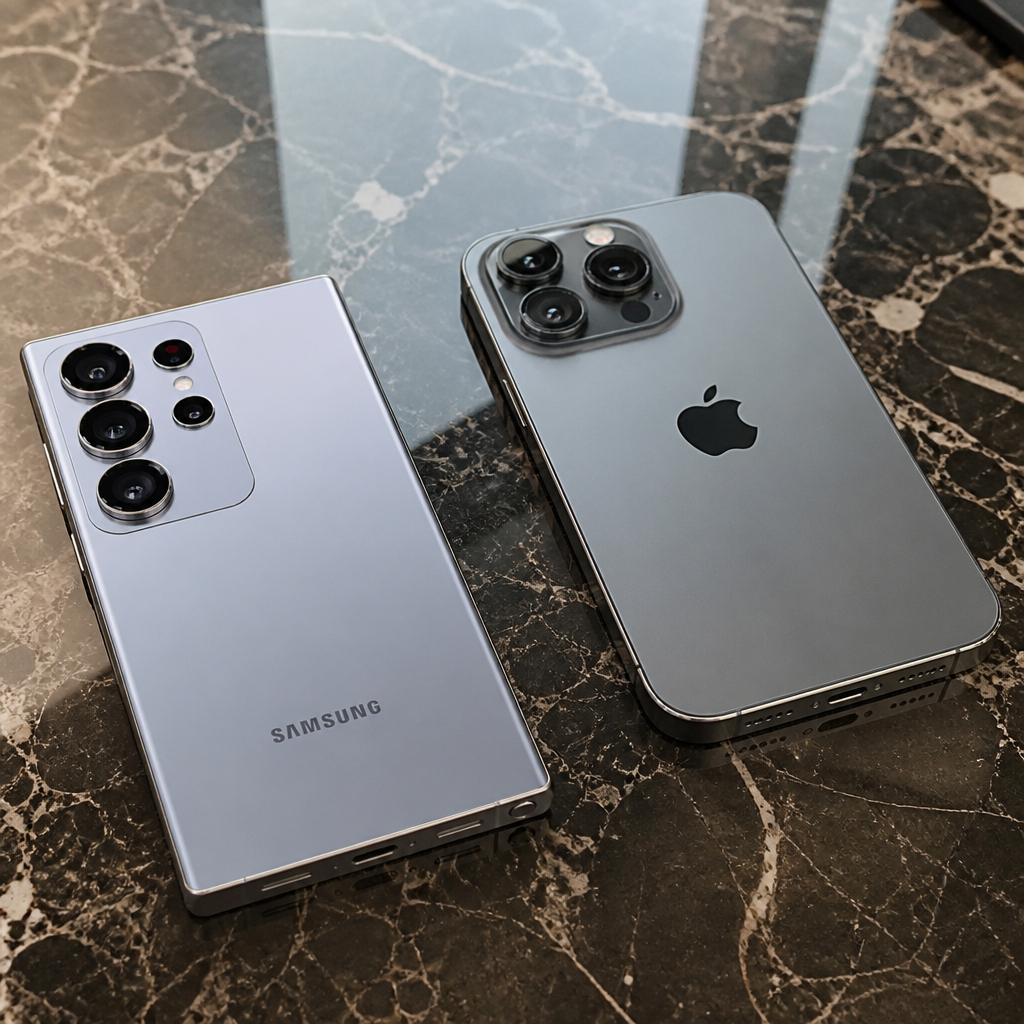
The Evolution of Smartphone Silhouettes
For over a decade, the smartphone industry has been defined by a fierce dichotomy of design languages. On one side stood Samsung, championing aggressive curves, expansive displays, and a relentless pursuit of futuristic, edge-to-edge futuristic canvases. On the other side stood Apple, pioneering industrial minimalism, flat titanium chassis, sharp symmetrical bezels, and unyielding geometric precision. These two distinct philosophies gave consumers a clear choice between organic fluidity and architectural rigor. However, industry whispers surrounding the conceptualization of the Galaxy S27 Ultra suggest that this long-standing visual barrier is finally beginning to crumble. The thought of a Samsung ultra-flagship adopting cues traditionally championed by Cupertino challenges everything we thought we knew about modern device aesthetics.
As manufacturing processes mature, the physics of pocket technology dictate certain inevitabilities. Ergonomics, internal thermal management, periscope telephoto housing, and battery density constraints force designers toward remarkably similar spatial conclusions. Yet, a design pivot toward a flatter, more symmetrically bordered chassis on the Galaxy S27 Ultra is not merely a capitulation to trends; it represents a mature convergence of what actually works in the palm of a user's hand. When industry titans begin to share design vocabularies, it signals that the form factor has reached an apex of functional utility, shifting the battleground entirely to internal architecture, software capability, and hardware innovation.
Ergonomics Meets Industrial Rigor
The historical critique of ultra-tier Samsung devices often targeted their razor-thin side profiles and dramatic curved glass edges. While undeniably striking in promotional imagery, these curves frequently resulted in accidental palm touches, a reduced surface area for secure gripping, and persistent durability vulnerabilities when dropped on hard surfaces. By potentially pivoting toward a flatter structural profile reminiscent of modern Apple iPhones, Samsung is prioritizing raw ergonomics and functional longevity over superficial drama. A flatter display surrounded by micro-curved bezel glass marries the tactile security of a boxy chassis with the swipe-friendly fluidity that Android power users demand.
- Enhanced structural integrity reducing screen vulnerability during impacts.
- Elimination of accidental touch registration along the extreme display edges.
- Optimized internal volume allowing for larger vapor chambers and dense battery cells.
- More secure purchase in the hand for one-handed operation and media consumption.
This structural evolution also fundamentally transforms how accessories interact with the device. Universal magnetic alignment ecosystems, folio cases, and desktop docking stations benefit immensely from uniform, flat side rails. If the Galaxy S27 Ultra adopts these architectural hallmarks, it will instantly streamline the accessory market, proving that premium industrial design is ultimately driven by how seamlessly a device integrates into the daily workflow of its owner.
The Psychology of Convergence
In the upper echelons of consumer electronics, design convergence is an inevitable byproduct of consumer preference. When millions of users vote with their wallets, manufacturers inevitably listen. The minimalist aesthetic popularized by Apple has proven to be timeless, resisting the rapid aging associated with aggressive, trend-chasing curvatures. Samsung recognizing this durability of style signifies a maturing corporate confidence. Instead of fighting for differentiation through novelty, the brand is positioning itself to win on execution, display fidelity, and ecosystem integration.
"True industrial design mastery is no longer about shouting the loudest with wild, eccentric forms; it is about refining the essential rectangle into an object of absolute, timeless perfection."
This psychological shift moves the conversation away from superficial clone accusations and toward a broader appreciation of industry best practices. When two masterclass engineering teams arrive at similar physical solutions, it validates those choices as the pinnacle of current material science. The consumer ultimately wins this silent war of shapes, inheriting a device that looks authoritative on a boardroom table yet feels utterly natural during extended multimedia sessions.
Display Technology and Bezel Reduction
One of the most thrilling implications of a flatter design language is the potential democratization of absolute bezel symmetry. Historically, curved screens allowed manufacturers to create the illusion of zero side bezels while hiding structural support components. However, this often compromised the utility of the extreme edges of the canvas, rendering stylus accuracy difficult near the drop-off points. A flat-screen approach on a massive ultra-tier canvas opens up entirely new possibilities for under-display sensor placement and uniform structural reinforcement.
- Achieving absolute symmetrical black borders around the entire perimeter of the screen.
- Maximizing the precise drawing surface for integrated stylus accessories without edge distortion.
- Enhancing polarized outdoor visibility by eliminating light refraction off curved edges.
- Simplifying screen protector installation and increasing tempered glass durability.
By refining the front face into a pristine, unblemished pane of glass, Samsung can focus its engineering brilliance on what truly matters: peak luminance, color accuracy, and variable refresh rate efficiencies. The absence of distracting curves draws the eye deeper into the content, creating an immersive window that honors both productivity and cinematic consumption.
The Future of Ultra-Tier Flagships
As we look toward the horizon of mobile technology, the debate over whether the Galaxy S27 Ultra looks like an Apple iPhone ultimately fades into the background, eclipsed by the sheer capability packed within. Form follows function, and when engineering constraints are solved with elegant minimalism, stylistic overlap becomes an inevitability rather than a coincidence. Samsung has always possessed the manufacturing prowess to bend titanium and glass to its will; pairing that muscle with a mature, ergonomic, and timeless silhouette might just yield the most complete mobile computer ever conceived.
Ultimately, the mark of a truly great device is not that it looks entirely alien, but that it feels completely inevitable the moment you hold it. Whether inspired by historical silhouettes or driven by pure ergonomics, the next generation of mobile hardware promises to blur the lines between competing philosophies, leaving us with refined tools that elevate our daily digital lives with uncompromising authority.