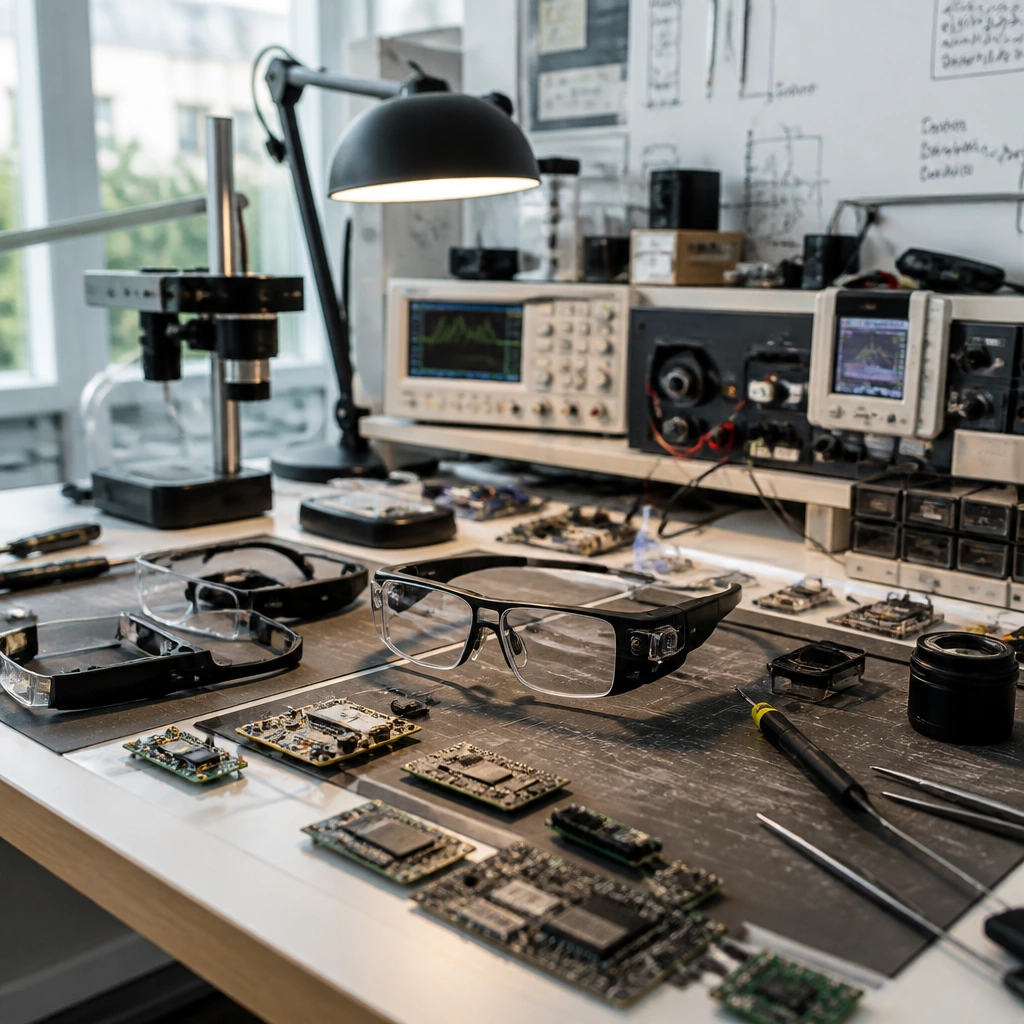
- The Weight Problem: Current hardware remains too bulky for all-day professional wear.
- Display Physics: Micro-OLED and waveguide optics are finally closing the gap on outdoor brightness.
- Standardization Clashes: Open standards like OpenXR are winning, but walled gardens still slow down progress.
Let's be candid: wearing a brick on your face for eight hours a day is nobody's idea of a good future. Yet, tech giants keep pitching heavy, glass-fronted goggles as the pinnacle of human-computer interaction. The reality on factory floors and remote engineering desks is starkly different. Workers want lightness, accuracy, and zero friction. If you are building for the spatial era, you need to understand the brutal physical limits of modern displays before writing a single line of shader code.
The Heavy Hardware Bottleneck
Batteries are heavy. Lenses are thick. Heat dissipation requires fans. These three engineering constants have crippled spatial computing adoption outside of niche enterprise pilots. Nobody wants to wear a device that leaves red indentations on their forehead after twenty minutes. Engineers talk endlessly about virtual objects floating in mid-air, but they rarely mention the neck strain.
- Thermal throttling kills high-refresh-rate tracking during intense tasks.
- Battery packs strapped to pockets create frustrating snag hazards on industrial sites.
- Field of view compromises force users to constantly turn their heads like owls.
The market is slowly waking up. Form factor must precede immersion. Until manufacturers solve the optics-to-weight ratio, augmented reality will remain an expensive novelty rather than a daily utility.
Optics, Waveguides, and the Brightness War
Step outside on a sunny afternoon with most consumer augmented reality glasses. What happens? The virtual screen vanishes. Sunlight completely overpowers micro-OLED projections. Solving outdoor brightness is the hardest physics problem in display engineering right now.
Waveguides bend light from a hidden projector into your retina, mixing digital photons with real-world light. Doing this efficiently without causing rainbow artifacts or blurry text edges requires microscopic precision. Manufacturers are experimenting with surface-relief gratings and holographic optical elements. The winner of this race will dictate how we interact with digital data outdoors.
| Aspect | Traditional Approach | Modern Solution |
|---|---|---|
| Display Source | LCD Panels | Micro-OLED & Micro-LED |
| Light Delivery | Direct Stacking | Waveguides & Diffractive Optics |
| Power Draw | High Wattage Draw | Sub-watt Optical Engines |
The Open Standards Tug-of-War
Remember the early days of mobile apps where you had to rewrite code for iOS and Android from scratch? Spatial computing is currently reliving that exact nightmare. Every hardware vendor wants their own proprietary software development kit. This fractures the developer community.
OpenXR has become the primary lifeline for sanity. By standardizing input tracking and rendering pipelines, developers can finally write code once and deploy it across multiple headsets. But adoption is sluggish. Big players love walled gardens because monopolies protect margins. The battle for open standards will determine whether the spatial web remains fragmented or becomes universally accessible.
Do not build proprietary UI frameworks for spatial applications. Stick strictly to OpenXR-compliant engines like Unity or Unreal with open-source toolkits to future-proof your codebase against hardware obsolescence.
What the Next Decade Actually Looks Like
Forget science fiction promises of fully immersive virtual worlds replacing the physical office. The near future is boring, practical, and deeply integrated into physical workflows. Think of heads-up maintenance manuals for mechanics, real-time spatial annotations for architects, and remote surgical assistance powered by ultra-low-latency video feeds.
- Context-aware interfaces will appear only when you look at specific machinery.
- Hand tracking will replace controllers for 90% of casual enterprise tasks.
- Edge computing will offload heavy rendering from the headset to local room servers.
Frequently Asked Questions
Why are current augmented reality glasses so expensive?
Custom silicon, high-density micro-OLED panels, and precision-molded glass waveguides are hideously expensive to manufacture at low volumes. Economies of scale have not caught up to consumer electronics pricing yet.
Will standalone headsets replace desktop monitors anytime soon?
Not for text-heavy work. While spatial displays offer infinite virtual screen real estate, current text clarity and edge distortion still lag behind standard 4K physical desktop monitors.