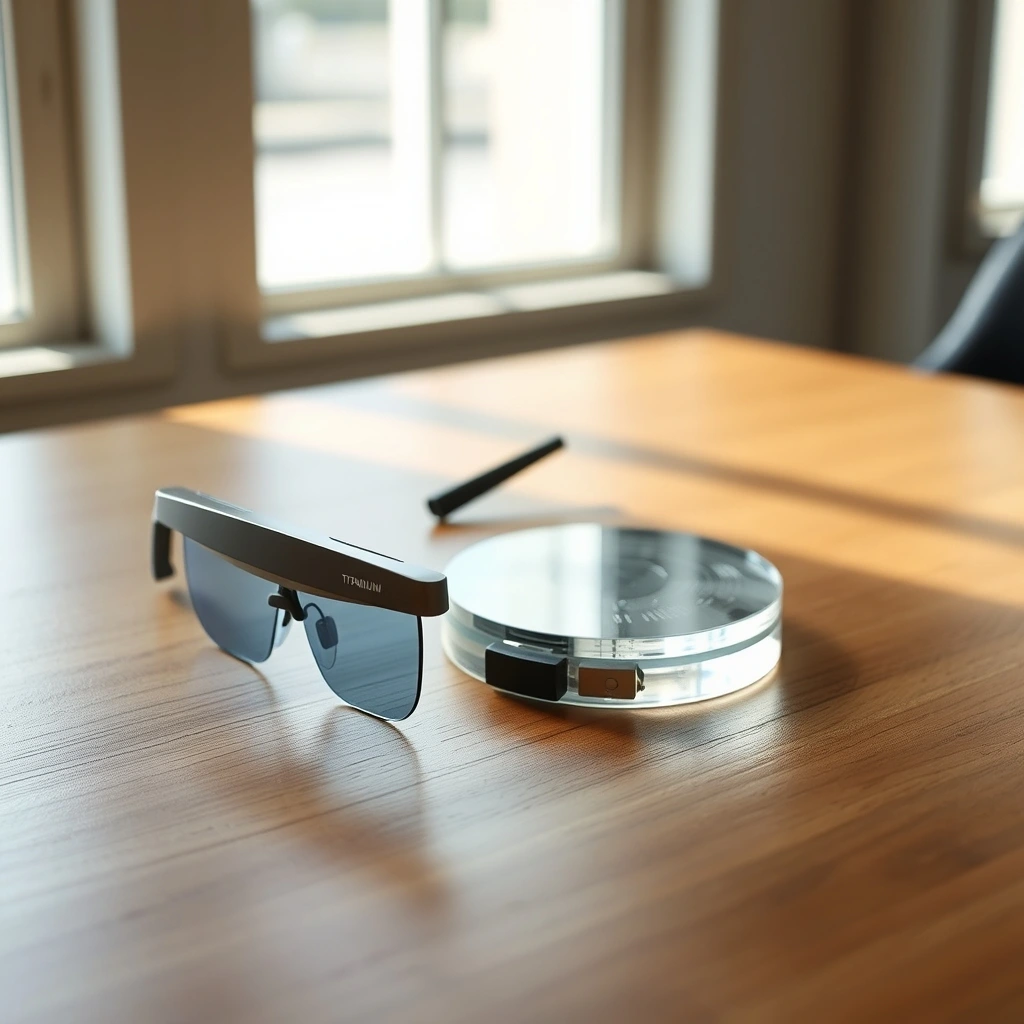
- Point 1: Hardware is shedding bulk, moving from clunky visors toward everyday optical frames.
- Point 2: Spatial interfaces now replace traditional desktop monitors for professional workflows.
- Point 3: Micro-LED and waveguide breakthroughs have finally solved the outdoor brightness bottleneck.
Let us be candid: the consumer electronics industry lied to you about augmented reality for a decade. Heavy headsets gather dust on shelves, tethered cables trip unsuspecting users, and battery life barely outlasts a sitcom. Yet, beneath the marketing noise, something fundamentally shifted. By mid-2026, the underlying physics of light, optics, and spatial tracking caught up with the hype. We are no longer waiting for the future. The hardware is finally usable.
The Death of the Flat Glass Monitor
For forty years, we stared at glowing rectangles. We tiled them, curved them, and mounted them on arms. That era is sputtering to a halt. Modern spatial computing environments project infinite virtual canvases directly into your physical workspace. You are no longer constrained by desk space. You have thirty browser windows floating around your kitchen, pinned in physical coordinates.
- Virtual screens persist precisely where you left them, even after a reboot.
- Eye-tracking replaces mice for primary target acquisition, dropping click latency to milliseconds.
- Hand gestures operate with subtle finger pinches rather than exaggerated, arm-tiring waves.
| Aspect | Traditional Approach | Modern Solution |
|---|---|---|
| Display Surface | Physical monitors and TVs | Dynamic spatial projections |
| Interaction Model | Mouse, keyboard, touch | Eye tracking and micro-gestures |
| Portability | Single laptop screen on the go | Infinite multi-monitor setup anywhere |
Optics That Refuse to Blind You
Early augmented reality glasses suffered from a fatal flaw: they looked like welder goggles indoors and became invisible under direct sunlight. That limitation vanished over the past eighteen months. Engineers bypassed traditional liquid crystal limitations by leaning hard into micro-LED arrays combined with custom diffraction waveguides.
The result? Glasses that weigh under seventy grams yet push enough nits to cut through a cloudless afternoon sky. Black levels actually look black instead of washed-out grey. Contrast ratios jumped past anything desktop monitors could achieve, making virtual objects indistinguishable from physical furniture.
Battery Realities and Thermal Physics
Here is what the spec sheets conveniently omit: power draw. Pushing millions of pixels into two tiny optical engines while running real-time SLAM (Simultaneous Localization and Mapping) algorithms generates intense heat. Nobody wants a mini toaster strapped to their temporal bone.
Hardware designers solved this through radical chiplet partitioning and auxiliary neck-band batteries. By shifting heavy computation to a pocket-sized puck or an ultra-low-power neural processing unit, smart glasses maintain comfortable thermal profiles during eight-hour workdays.
Do not buy first-generation consumer spatial hardware expecting a flawless standalone computer. Treat current devices as high-performance tethered peripherals for your workstation until standalone thermal management matures fully next year.
The Social Friction Factor
Technology fails when it isolates the user from the room. Early head-mounted displays created antisocial bubbles, cutting off eye contact entirely. Modern spatial computing approaches this differently. Electrochromic glass panels dynamically tint when you launch an immersive application, but instantly clear when someone walks into your field of view.
- Automatic passthrough modes trigger the moment a human voice is detected nearby.
- Subtle external indicator lights signal to coworkers when you are busy versus available.
- Audio spatialization uses directional bone conduction, keeping your ears open to real-world sounds.
Frequently Asked Questions
Are these devices safe for daily, prolonged eye use?
Yes. Modern displays project light at infinity focus planes, eliminating the convergence-accommodation conflict that caused eye strain in older virtual reality headsets. You can read spatial text for hours without the typical fatigue associated with close-up screens.
When will traditional monitors become obsolete?
They will not disappear entirely, much like vinyl records or physical books. However, for mobile professionals, software engineers, and data analysts, spatial displays are already replacing secondary and tertiary monitors.