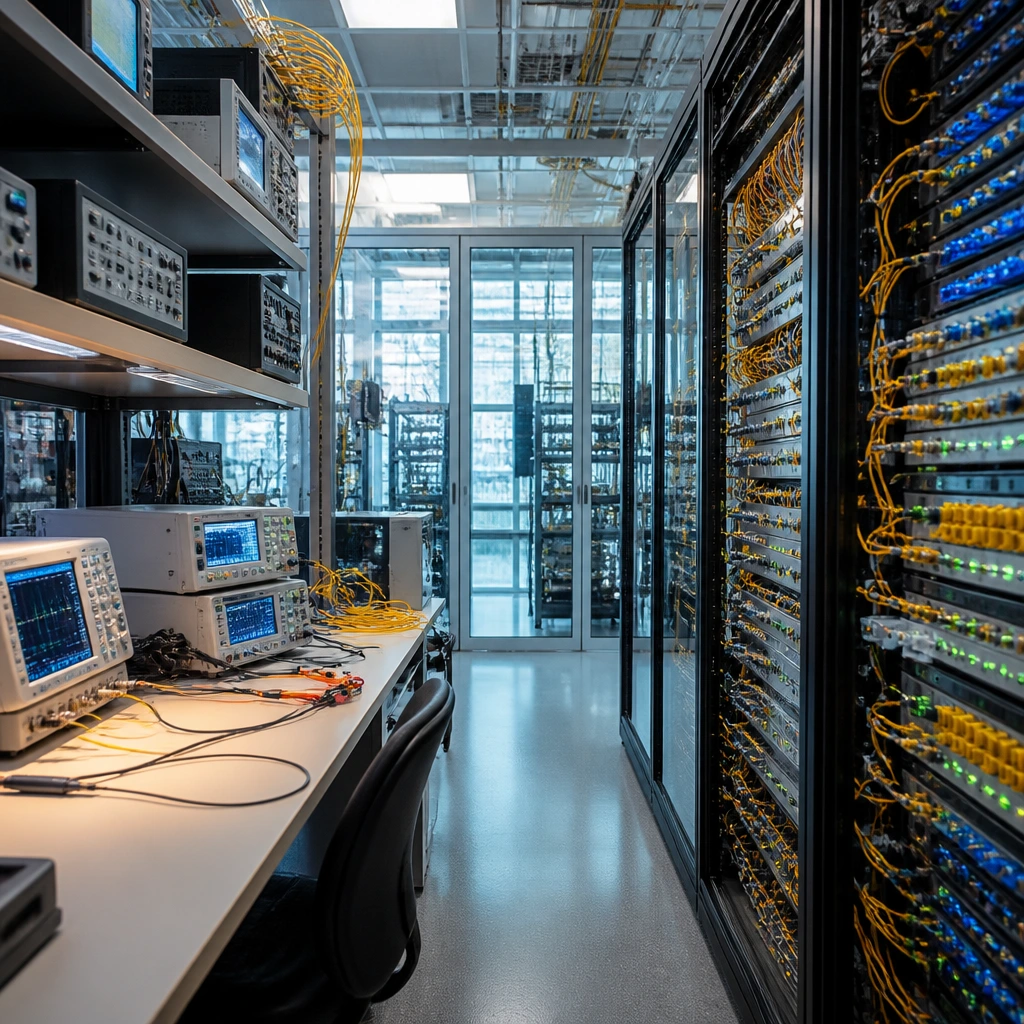
- Point 1: 6G targets sub-millisecond latency paired with terabit-per-second speeds, rendering current wireless limits obsolete.
- Point 2: Artificial intelligence will not just run on 6G networks; AI will be the fundamental operating system managing the spectrum itself.
- Point 3: Industrial automation, remote surgery, and holographic enterprise communications move from sci-fi tropes to operational necessities.
Let us be candid: most corporate IT departments are still struggling to justify the ROI on their 5G investments. Now, a much faster wave is gathering on the horizon. Laboratories are already testing infrastructure that will make today's fastest mobile connections look like dial-up. This is not just an incremental speed bump. It is a total architectural reinvention of how global machinery, artificial intelligence, and human operators share information.
The Speed Trap Nobody Wants to Talk About
Everyone obsesses over raw download speeds. Terabits per second sound fantastic in marketing brochures. But chasing sheer speed misses the real point of the upcoming telecommunications shift. The primary breakthrough lies in deterministic latency dropping down to fractions of a millisecond. When data moves instantly between devices, the physical distance between servers and sensors practically vanishes.
Think about autonomous heavy machinery operating in remote mining sites. Current networks drop packets just often enough to force safety buffers. Engineers dial down speeds to prevent catastrophic errors. Future wireless standards eliminate those buffers entirely. Machines react faster than human reflexes. They coordinate in real time without human intervention.
Merging Intelligence and Spectrum
Here's what nobody tells you about the engineering behind next-generation connectivity: traditional radio frequency management is dead. Humans cannot program algorithms fast enough to handle the sheer volume of connected nodes. Artificial intelligence must step in.
- Dynamic spectrum sharing that self-optimizes based on localized demand.
- Predictive beamforming that tracks moving objects before they change trajectory.
- Autonomous network slicing that allocates dedicated bandwidth per micro-task.
Without machine learning baked directly into the hardware layer, the network would collapse under its own complexity. This deep fusion of neural networks and radio waves transforms infrastructure into a living, thinking utility.
The Hardware Reckoning Inside the Data Center
You cannot run a terabit-per-second network on old silicon. The hardware stack inside enterprise server rooms faces a brutal upgrade cycle. Processors must handle massive parallel data streams without melting down from thermal overload. Edge computing nodes must migrate closer to the actual point of data collection.
| Aspect | Traditional Approach | Modern Solution |
|---|---|---|
| Data Processing | Centralized cloud servers | Distributed edge AI nodes |
| Latency Target | 10 to 50 milliseconds | Sub-millisecond response |
| Spectrum Management | Static allocations | AI-driven dynamic sharing |
Why Enterprise Architects Are Panicking Early
Corporate budgets operate on three-to-five-year planning cycles. Telecommunications infrastructure operates on decade-long horizons. This mismatch creates acute anxiety for chief technology officers. Buy too early, and you deploy proprietary gear that gets abandoned when global standards finalize. Wait too long, and agile competitors out-automate your entire supply chain.
Stop buying standalone wireless upgrades. Instead, audit your current data pipeline architecture. If your internal applications cannot process streaming telemetry at high frequency today, faster radio waves will only expose your software bottlenecks faster.
Frequently Asked Questions
When will real-world deployments actually begin?
Commercial rollouts will likely begin in the early 2030s, following standard decade-long cellular generation cycles. However, enterprise pilots and specialized industrial use cases are already taking shape in closed laboratory environments.
Will current devices work on the new networks?
No. The frequency bands required for these speeds—specifically entering the terahertz range—demand entirely new antenna designs and semiconductor materials that current consumer handsets simply cannot support.