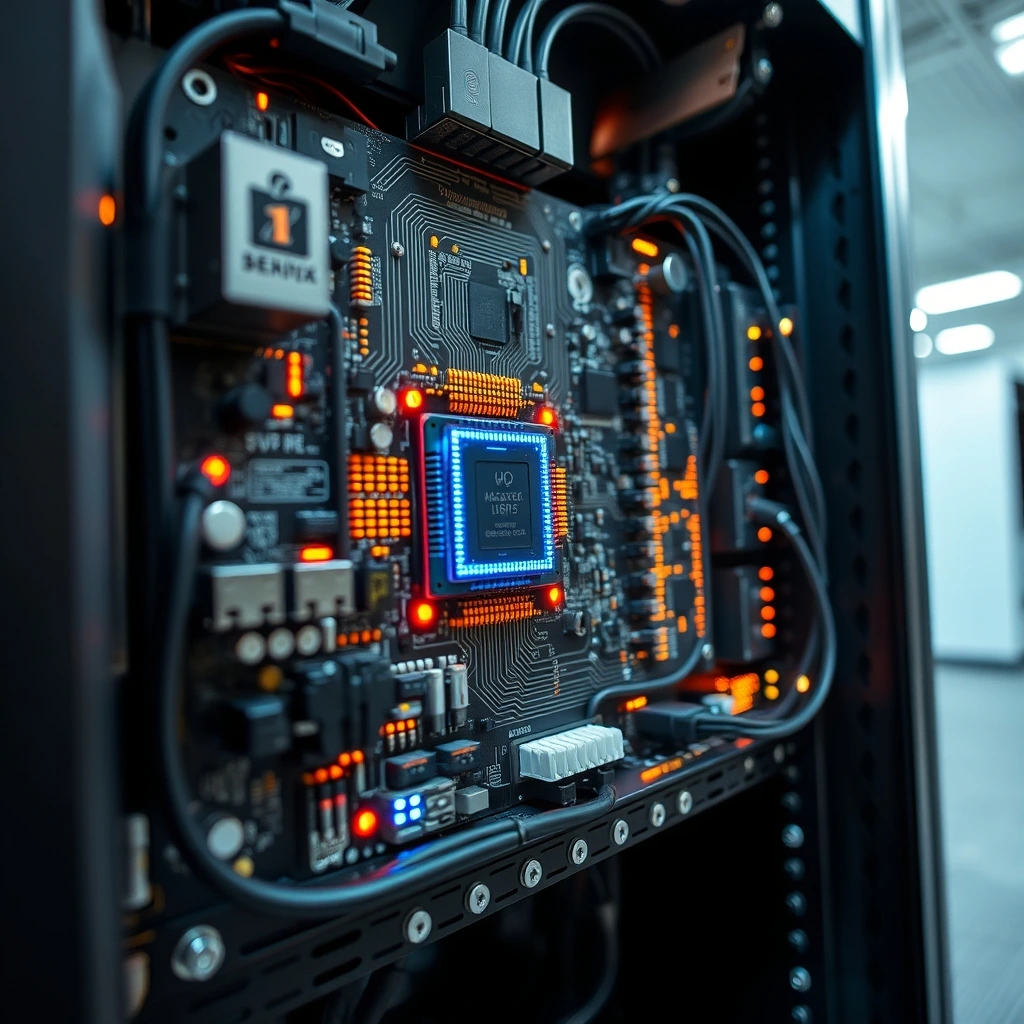
- Point 1: 6G abandons traditional human-driven design for native artificial intelligence integration from day one.
- Point 2: Terahertz frequency bands demand radical new hardware approaches and localized computing nodes.
- Point 3: The physical architecture merges sensing and communication into a single unified spectrum.
Let us be candid: the hype surrounding fifth-generation cellular networks was mostly marketing noise. Operators sold you blazing-fast download speeds while quietly ignoring the glaring architectural bottlenecks that remain baked into legacy hardware. Now, whispers of sixth-generation standards fill corporate boardrooms, but the playbook has fundamentally broken. This transition is not about streaming movies in a fraction of a second. It is a grueling, high-stakes battle over decentralized machine intelligence, spectrum scarcity, and sovereign data pipelines.
The Death of Dumb Pipes
Historically, telecommunications networks acted as neutral conduits. Packets went in; packets came out. Simple. Effective. Completely obsolete.
Future wireless architecture treats every connected base station, mobile terminal, and edge router as an autonomous computing node. Network operators can no longer afford the round-trip latency of sending telemetry data to centralized cloud servers for processing. The sheer volume of traffic generated by autonomous vehicles, industrial robotics, and immersive holographic displays makes centralized architecture an impossibility.
- Distributed machine learning models reside directly on radio access nodes.
- Spectrum management adapts in real-time without human intervention.
- Energy consumption drops through predictive power-scaling algorithms.
Here is what nobody tells you about this transition: the engineering talent capable of bridging radio frequency engineering with deep neural network optimization is extraordinarily rare. Companies attempting to buy their way out of this talent deficit via software licensing will watch their capital burn.
Terahertz Frequencies and the Physics Problem
Moving up the frequency spectrum opens up massive contiguous blocks of bandwidth, but physics remains remarkably stubborn. Terahertz waves behave almost like visible light. They struggle with blockage, atmospheric absorption, and diffraction.
You cannot simply blast a terahertz signal from a distant macro tower and expect it to penetrate reinforced concrete. It fails. Hard.
| Aspect | Traditional Approach | Modern Solution |
|---|---|---|
| Frequency Usage | Sub-6 GHz and millimeter-wave bands | Terahertz (THz) combined with sub-terahertz |
| Cell Topology | Macro towers covering wide geographic areas | Ultra-dense micro-cells with intelligent surfaces |
| Resource Allocation | Static frequency assignment by regulators | Dynamic, AI-driven spectrum sharing and sensing |
Overcoming these propagation limits requires re-architecting the physical environment itself. Intelligent reflecting surfaces—essentially smart wallpaper coated with metamaterials—will bounce signals around corners. Every office building, highway median, and residential apartment wall becomes an active participant in the routing mesh.
Sensing and Communication Collide
For decades, radar systems and cellular networks lived in entirely separate universes. One tracked physical objects; the other carried voice and data. The boundary line is about to vanish.
6G networks use high-frequency radio waves not just for connectivity, but as continuous radar. The network maps its environment in three dimensions simultaneously while transmitting data. It knows when a pedestrian steps off a curb because the reflection profile of the radio wave shifts instantly.
Do not wait for international standards bodies to finalize specifications before shifting your R&D focus. Build modular hardware prototypes that can adapt dynamically via firmware updates to whatever frequency band wins regulatory approval.
This convergence creates massive privacy concerns. When the infrastructure itself doubles as a high-precision surveillance and motion-tracking apparatus, regulatory compliance becomes an absolute minefield.
The Energy Conundrum
More bandwidth usually means more power consumption. If current power scaling trends hold, running future communication networks would require the output of several medium-sized nuclear reactors dedicated entirely to cellular base stations.
Engineers are fighting back through extreme hardware minimalism and context-aware sleep cycles. Radios must wake up for microseconds, execute a data burst, and power down completely. Artificial intelligence coordinates this choreography across millions of independent nodes to prevent grid collapse.
Frequently Asked Questions
When will real 6G networks actually launch?
Commercial deployments are not expected until the early 2030s. Right now, academic labs and standards organizations are hammering out the foundational theoretical frameworks and channel models.
Will existing 5G infrastructure become completely useless?
Not overnight. Much of the standalone 5G core architecture and fiber-optic backhaul deployed today will serve as the foundation for early hybrid deployments before pure terahertz air interfaces take over.