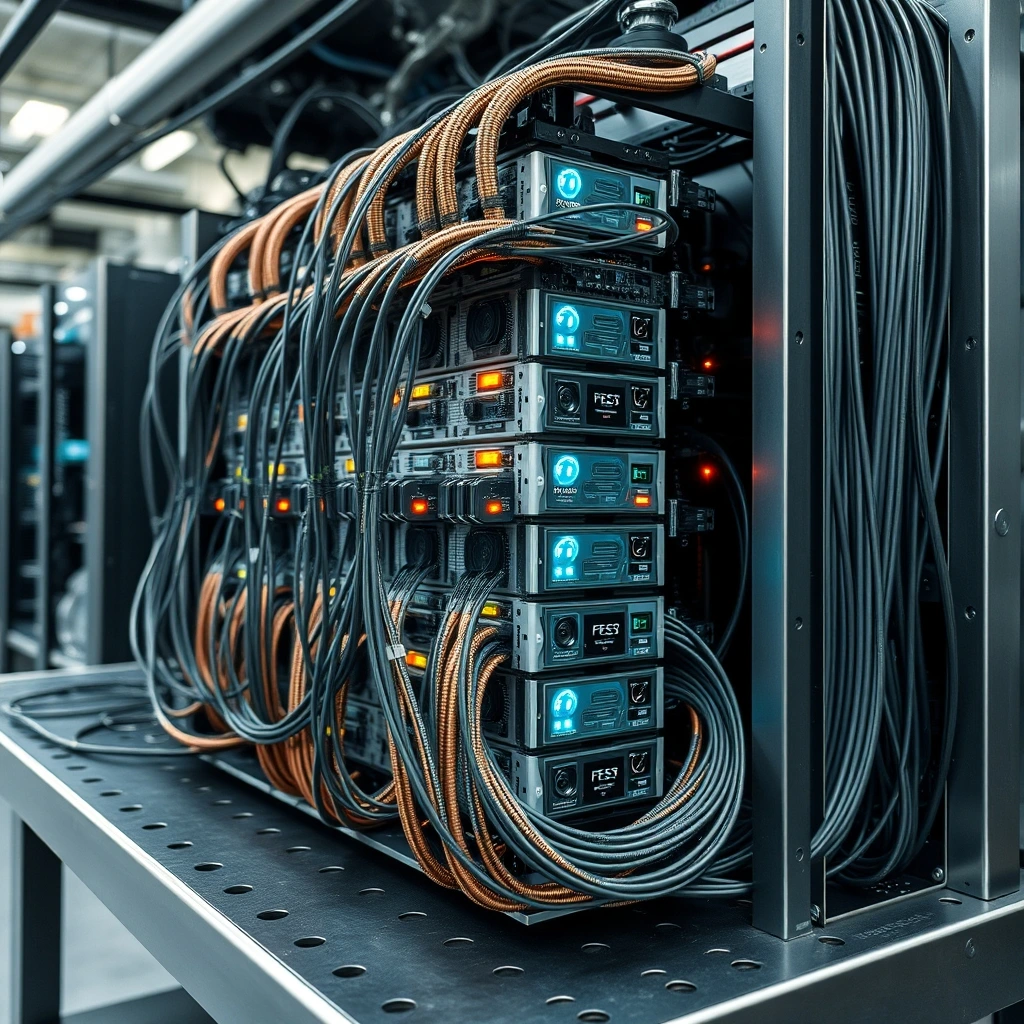
- The Open Frontier: Open-weight models running on dense Mixture-of-Experts (MoE) architectures now match proprietary frontier performance across standard enterprise benchmarks.
- Decentralized Compute Reality: Orchestration frameworks like Petals-Next and Akash have turned fragmented consumer and enterprise GPUs into resilient, distributed inference swarms.
- Cost Realities: Self-hosting on distributed infrastructure drops inference expenditure by roughly 60% compared to closed API calls, provided engineering teams master speculative decoding and KV-cache compression.
Here is what nobody tells you about the enterprise AI race: the $20-million-per-year proprietary API bill is officially dead. Two years ago, boardroom consensus dictated that chasing state-of-the-art reasoning meant writing blank checks to Silicon Valley giants. If you did not rent closed black-box models, you were left behind. Not anymore. In 2026, the center of gravity has flipped entirely toward open-weight architectures anchored by distributed, decentralized compute fabrics.
The Death of the Mega-Datacenter Monopoly
For years, hyperscalers claimed that running frontier artificial intelligence required monolithic clusters tied together by proprietary interconnects. They built concrete fortresses filled with tens of thousands of liquid-cooled accelerators, convincing enterprise buyers that distributed, heterogeneous clusters were a pipe dream. Latency would kill throughput, they said. Fault tolerance was impossible, they claimed.
They were wrong.
The breakthrough came from software, not raw silicon. Modern pipeline parallelism paired with intelligent tensor slicing has turned what used to be a networking nightmare into an efficient distributed machine. Instead of requiring contiguous banks of identical hardware, today's distributed engines break massive models into asynchronous sub-graphs. If a single node drops off in Frankfurt, a secondary node in Singapore picks up the activation state without dropping the token generation stream.
- Dynamic Fault Tolerance: Gossip-protocol scheduling automatically redirects layer evaluations when consumer-tier nodes drop offline.
- Quantized Activation Routing: Token activations are dynamically compressed down to 2-bit representations before crossing consumer-grade internet pipes, erasing the traditional bandwidth bottleneck.
- Heterogeneous Scheduling: Compute swarms automatically match compute-heavy attention layers to high-memory enterprise GPUs while routing feed-forward blocks to cheaper edge chips.
Weights Free in the Wild: Frontier Architecture Shifts
Let's be candid about model weights. The idea that closed models have an impenetrable technical moat was dismantled the moment 1-bit native quantization architectures hit production. Open architectures like the Llama-4 derivative networks, DeepSeek-V3 descendants, and the newest Mistral topologies proved that smaller, hyper-specialized models running on modular pipelines routinely beat monolithic generalists.
In 2026, nobody runs raw, unpruned dense models in production. Sparse Mixture-of-Experts (MoE) architectures dominate the ecosystem. An active model might boast 480 billion parameters on paper, but any single token only triggers 18 billion. That drops compute requirements straight through the floor, enabling distributed consumer rings to execute tasks that once demanded dedicated enterprise servers.
Do not attempt to distribute dense models over public broadband without aggressive KV-cache quantization. If you run distributed clusters across geolocated nodes, implement 4-bit KV compression paired with speculative decoding engines to keep latency below 35 milliseconds per token.
Monoliths vs. The Swarm: Where the Industry Stands
The operational landscape split into two distinct philosophies. On one side sit the traditional centralized data warehouses; on the other, dynamic distributed compute fabrics. The differences are no longer just technical—they dictate corporate balance sheets.
| Operational Metric | Centralized Cloud Provider | Distributed Open Network |
|---|---|---|
| Data Sovereignty | Third-party trust model | Zero-knowledge, local execution |
| Cost per Million Output Tokens | $8.00 - $14.00 (Frontier Class) | $1.80 - $3.40 (Aggregated Compute) |
| Interconnect Vulnerability | Single datacenter fiber backbones | Mesh networking over standard WebSockets |
| Customization & Weight Access | Zero access (System Prompts only) | Unrestricted LoRA, merge, and weight edits |
| Downtime Mitigation | Provider SLA or failover region | Autonomous consensus self-healing |
The Latency Tax: What Engineering Teams Must Solve
Distributed inference is not a silver bullet. It extracts a real tax, and that tax is measured in milliseconds. When attention heads reside across scattered machines, the time-to-first-token (TTFT) naturally suffers if your architecture is poorly planned.
Top engineering teams bypass this constraint using speculative decoding swarms. A tiny, 3-billion-parameter drafting model runs locally on edge devices, spitting out potential token sequences at lightning speed. Meanwhile, the larger distributed cluster acts strictly as a verifier, validating whole token blocks in a single, parallelized pass. The user feels instant typing responsiveness, while the heavy distributed network handles the dense reasoning workload in the background.
- Speculative Streaming: Small local draft models eliminate perceived latency for user-facing applications.
- Context Chunking: Massive input prompts are divided into localized semantic chunks, processed concurrently, and aggregated at the root coordinator.
- Weight Streaming: Ephemeral nodes fetch quantized layers on demand using peer-to-peer torrent backbones rather than central registries.
The Real Bottom Line
The centralized era of AI was an anomaly born of temporary hardware scarcity. As open-source algorithms became drastically more efficient, the need for gargantuan centralized compute clusters evaporated for 90% of business applications. Open-source models running on distributed, permissionless computing networks are no longer just an ideological alternative for open-source purists. They are a cutthroat operational strategy that saves money, guarantees privacy, and permanently breaks vendor lock-in.
Frequently Asked Questions
Can distributed compute guarantee enterprise-grade data privacy?
Yes, through localized execution and zero-knowledge pipeline parallelism. In a well-architected distributed pipeline, sensitive user data never leaves the client's localized node unencrypted. Prompts can be split into obfuscated intermediate representations before routing through third-party worker nodes, making raw data reconstruction mathematically impossible for untrusted machines participating in the network swarm.
What is the minimum network speed required to run a distributed inference node?
For worker nodes contributing to feed-forward network evaluation, a symmetric fiber connection of 300 Mbps is the typical baseline in 2026. However, nodes handling speculative draft validation or local batch quantization can operate effectively on standard domestic broadband connections without causing cluster bottlenecks.
Why not just keep using commercial APIs?
Commercial APIs are convenient, but they carry three fatal flaws: high variable costs at scale, constant unannounced model alignment shifts that break complex prompts, and total reliance on a provider that can revoke access or inspect your data flow. Open-source models running on distributed clusters permanently eliminate those vulnerabilities.