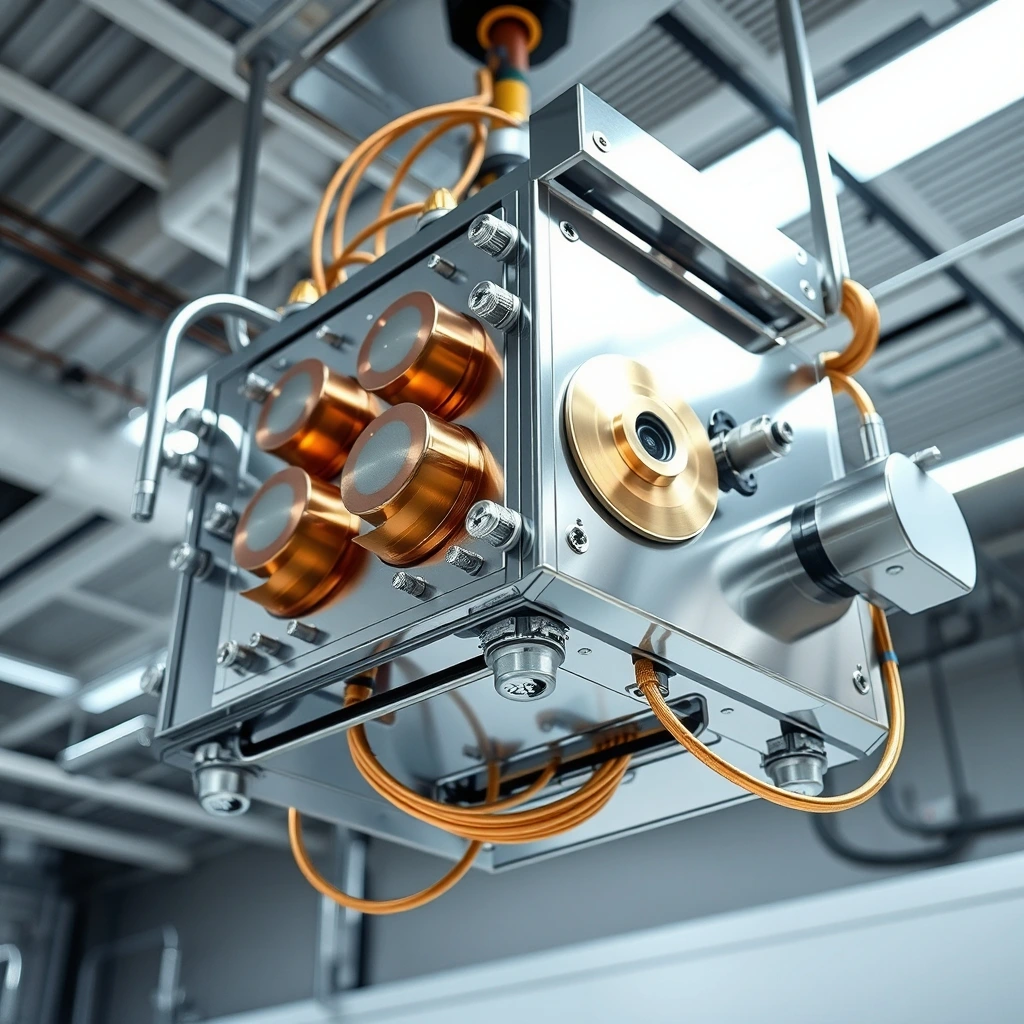
- Qubit Counts Lie: Physical qubits mean nothing without fault-tolerant logical qubits and low error rates.
- Hybrid Compute Wins: Classical high-performance clusters paired with targeted quantum processors deliver today's only viable commercial edge.
- PQC is Non-Negotiable: NIST's standardized post-quantum cryptography frameworks require immediate migration before harvesting attacks mature.
Walk into any physics laboratory working on superconducting circuits, and you will hear a rhythmic, metallic thumping. It is the pulse tube compressor keeping the dilution refrigerator hovering at fifteen millikelvin—colder than deep space. For years, vendor pitch decks treated that sound like the heartbeat of an imminent tech utopia. They promised broken encryption by Tuesday and cure-all chemistry by Friday. Let's be candid: most of that was unadulterated noise. Yet beneath the promotional froth, something quietly shifted over the past eighteen months. We crossed the threshold from noisy bench experiments into verifiable computational utility.
The Road Behind Us: Moving Past Lab Curiosities
Remember 2019? Google claimed quantum supremacy with Sycamore, running a random circuit sampling task in 200 seconds that they argued would take a classical supercomputer ten millennia. Classical researchers at IBM punched back weeks later, proving a well-tuned supercomputer could simulate it in days. That squabble taught the industry a painful lesson. Demonstrating a synthetic math trick inside an ultra-cold fridge does not equal enterprise value.
The milestones that actually mattered came later, away from mainstream headlines:
- Neutral Atom Runtimes: Platforms using laser-trapped neutral atoms proved dynamic shuttling, enabling all-to-all connectivity without rigid physical wiring.
- Logical Qubit Breakthroughs: Teams demonstrated error correction where fault-tolerant logical qubits demonstrated lower error rates than the physical components supporting them.
- Quantum Utility Benchmarks: Systems tackling 100-plus qubit unmitigated circuits started outperforming brute-force tensor network classical approximations on real condensed-matter physics problems.
We spent sixty years optimizing classical Von Neumann architecture. Expecting quantum processors to displace enterprise databases overnight was foolish. Instead, quantum chips are evolving into specialized coprocessors, tackling specific, intractable mathematical geometry.
Where the Math Actually Works: Concrete Applications
If quantum computers are not cracking Bitcoin wallets or scheduling regional airline routes this morning, what are they doing? They are simulating nature on nature's terms. Classical computers struggle with quantum mechanical systems because the Hilbert space scales exponentially with every electron added. Simulate a modest molecule with forty interacting electrons, and your classical RAM melts.
Here is where real industrial teams are running actual circuits:
- Materials Science & Battery Cathodes: Modeling lithium-ion degradation and transition-metal oxide bonding states directly informs energy storage life cycles without synthesizing hundreds of physical test alloys.
- Catalysis and Nitrogen Fixation: The Haber-Bosch process consumes roughly 1-2% of global energy supply. Simulating the active site of nitrogenase enzymes remains impossible on classical chips, but hybrid quantum algorithms are mapping the electronic pathways.
- Complex Covariance in Finance: Financial institutions have stopped looking for magic arbitrage buttons. Instead, they use quantum-assisted Monte Carlo algorithms to speed up risk exposure calculations and balance sheet stress tests.
Stop hunting for standalone quantum applications. Every successful corporate deployment running right now utilizes an HPC-quantum hybrid setup. Your data pipeline stays in C++ or Python on classical clusters; you only offload small, mathematically stubborn kernel operations to quantum hardware.
The Shifting Landscape: Hardware Architecture Matchup
Not all qubits are engineered the same way. The industry has fractured into distinct hardware camps, each wagering billions on radically different physics.
| Architecture | Core Mechanism | Operational Trade-off |
|---|---|---|
| Superconducting Loops | Lithographed Josephson junctions cooled to millikelvin ranges | Extremely fast gate speeds, but high error rates and brutal refrigeration overhead |
| Trapped Ions | Electromagnetic fields suspending charged ytterbium or barium ions | Near-perfect coherence and gate fidelities, but slow clock cycles and scaling bottlenecks |
| Neutral Atoms | Rubidium or cesium atoms held by optical tweezers | Massive scale, reconfigurable 3D geometries, though shuttle control remains nascent |
| Silicon Spin Qubits | Electron spins trapped in modified CMOS semiconductor quantum dots | Leverages existing chip fabs, but highly sensitive to local substrate impurities |
The Clock is Ticking on Security Standards
Here is what nobody tells you about the timeline: adversaries do not need a working fault-tolerant quantum computer today to compromise your infrastructure tomorrow. Through 'Harvest Now, Decrypt Later' operations, state actors and rogue syndicates intercept and stash encrypted enterprise traffic across the wire. When Shor's algorithm finally runs at scale, they simply decrypt the archive.
The defense playbook changed when the National Institute of Standards and Technology (NIST) released its definitive Post-Quantum Cryptography (PQC) standards:
- FIPS 203: Module-Lattice-Based Key-Encapsulation Mechanism (derived from CRYSTALS-Kyber), engineered for general public key encryption.
- FIPS 204: Primary digital signature standard (CRYSTALS-Dilithium) handling modern digital identity authentication.
- FIPS 205: Stateless hash-based digital signature alternatives (SPHINCS+) designed as an algorithmic hedge against lattice vulnerabilities.
Migrating enterprise protocols from RSA-2048 and Elliptic Curve Cryptography to these lattice-based schemes is not an overnight patch. It impacts packet sizes, TLS handshakes, and hardware acceleration chips across global supply chains. If your engineering roadmap has not mapped cryptographic inventory, you are already behind schedule.
Building Software Without the Noise
Ten years ago, you had to write pulse-level microwave instructions to execute a two-qubit gate. Now, developer frameworks look surprisingly pedestrian. You write high-level Python routines in Qiskit, Cirq, or PennyLane, which compile down to intermediate representations before hitting cloud hardware brokers.
The immediate challenge is software-level error mitigation. Because fully error-corrected logical machines with millions of physical qubits sit a decade out, modern practitioners deploy zero-noise extrapolation and probabilistic error cancellation. We are extracting actionable signal from inherently noisy platforms through clever statistical tricks.
Frequently Asked Questions
Will quantum computers replace classical PCs and silicon servers?
Never. Quantum hardware cannot stream 4K video, execute relational database lookups, or handle typical operating system interrupts efficiently. They operate strictly as highly specialized accelerators for mathematically niche matrix, linear algebra, and Hamiltonian simulation problems.
How far away is a cryptographically relevant quantum machine?
Most sober consensus estimates place a machine capable of breaking RSA-2048 with Shor's algorithm between 2032 and 2038. Doing so requires thousands of stable, error-corrected logical qubits, which demands millions of physical qubits with current noise baselines.
Can artificial intelligence benefit from quantum computing today?
Quantum Machine Learning (QML) produces elegant academic papers, but classical GPU clusters still dominate production AI. Early hybrid quantum kernels show theoretical promise in parsing structured topological data and specific graph analytics, yet training massive transformers remains an exclusively classical endeavor.
The Bottom Line
Ignore the hype cycles claiming humanity will wake up next month to an unshielded quantum revolution. The reality is far more grounded, technically fascinating, and quietly productive. Engineering teams are methodically stitching superconducting loops and trapped atoms into classical computing clusters, mapping molecular orbitals, and locking down data networks against future decryption. The revolution isn't coming with a bang; it is being assembled, bolt by bolt, at fifteen millikelvin.