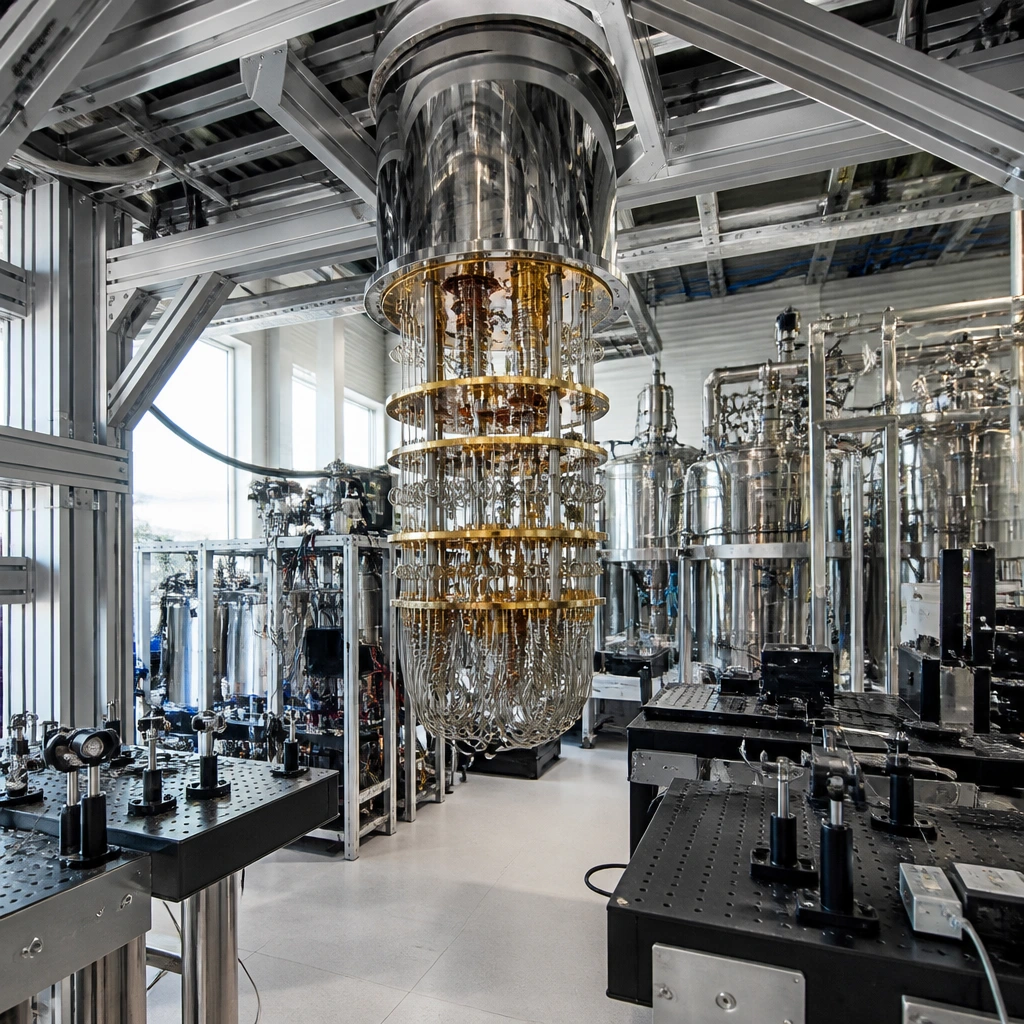
- The Noise: Public announcements often conflate raw physical qubits with fault-tolerant, error-corrected logic units.
- The Reality: Cryptographic vulnerability is real, but widespread commercial utility remains years away for most enterprises.
- The Standard: Post-quantum cryptography standardization is the immediate priority for engineering teams right now.
Let's be candid: most commentary on quantum hardware reads like science fiction pasted into a corporate press release. While tech giants trade blows over arbitrary qubit counts, software engineers and security architects are left staring at an abyss of uncertainty. Here is what nobody tells you about the actual state of the industry.
The Noise Versus The Ledger: Where Milestones Actually Stand
Counting physical qubits is a marketing trap. Early machines boasted impressive raw numbers, but noise destroyed the data before calculations finished. This is the decoherence problem. Without quantum error correction, a thousand noisy qubits cannot outperform a standard laptop on complex tasks.
- Physical Qubits: Raw building blocks plagued by environmental interference and extreme thermal sensitivity.
- Logical Qubits: The golden standard formed by clustering physical units together to suppress operational errors.
- Fault Tolerance: The threshold where calculations run indefinitely without degrading the underlying information state.
Researchers recently crossed critical error-correction thresholds, proving that logical qubits can outlive their constituent parts. This single achievement separates serious laboratory progress from mere PR stunts.
Practical Applications: What Works Today And What Remains Pipe Dreams
Do not expect a quantum processor to draft your emails or speed up your video rendering anytime soon. Classical architectures handle those workloads efficiently. Instead, quantum systems excel at simulating molecular interactions, optimizing massive supply chains, and breaking legacy encryption.
| Aspect | Traditional Approach | Modern Solution |
|---|---|---|
| Molecule Simulation | Approximations scaling exponentially | Exact quantum state modeling |
| Route Optimization | Heuristic algorithms with local traps | Global superposition pathfinding |
| Encryption | RSA and ECC math assumptions | Post-quantum lattice cryptography |
Material science sees the earliest wins. Pharmaceutical labs use near-term hybrid algorithms to model molecular catalysts, bypassing years of trial-and-error chemistry.
Stop waiting to buy a quantum machine. Cloud-hosted quantum-classical hybrid access through major providers lets your team test algorithms today without multi-million-dollar cryogenic infrastructure investments.
The Race for Future Standards and Cryptographic Survival
Harvest now, decrypt later. Malicious actors are already storing encrypted enterprise data today, waiting for the day a sufficiently powerful machine cracks standard RSA encryption. This threat forces global standardization bodies to scramble.
- Migration Timelines: Organizations must inventory legacy cipher suites before compliance deadlines arrive.
- Interoperability: Hybrid certificates combining traditional and post-quantum keys ensure zero downtime during transitions.
Ignoring these standards means waking up to compromised proprietary intellectual property the moment scalable quantum hardware hits the commercial market.
Building a Strategy Without Falling for Vaporware
Allocating enterprise budget requires brutal prioritization. You cannot afford to ignore the technology, but you certainly cannot afford to burn capital on immature hardware platforms.
- Audit existing codebases for cryptographic dependencies immediately.
- Train core engineering teams in linear algebra and quantum programming frameworks.
- Partner with specialized academic labs rather than building internal cryogenic facilities from scratch.
Pragmatism wins this race. The organizations surviving the transition will be those treating quantum readiness as a gradual migration rather than an overnight switch.
Frequently Asked Questions
When will quantum computers render standard encryption completely useless?
Estimates range from 2030 to 2040. However, the exact timeline depends entirely on scaling error-corrected logical qubits rather than raw physical counts. The risk is immediate because data stored today can be decrypted retroactively.
Do small businesses need to worry about quantum computing right now?
Unless you handle highly classified national security data or long-lifecycle proprietary assets, your immediate focus should be adopting post-quantum standards as software vendors update their tools, rather than buying hardware access.