- Cloud Latency Kills: Real-time robotic navigation cannot rely on round trips to remote servers.
- Silicon Constraints: Thermal limits on mobile units restrict pure compute scale.
- Distributed Processing: The winning formula splits loads between local micro-nodes and centralized fleets.
Here's what nobody tells you: cloud robotics is hitting a brutal physical wall. Send a high-resolution lidar stream across a cellular network, and watch your latency spike past critical safety thresholds. You cannot wait fifty milliseconds for a data center to decide whether an autonomous mobile robot should brake.
The Myth of Infinite Cloud Compute
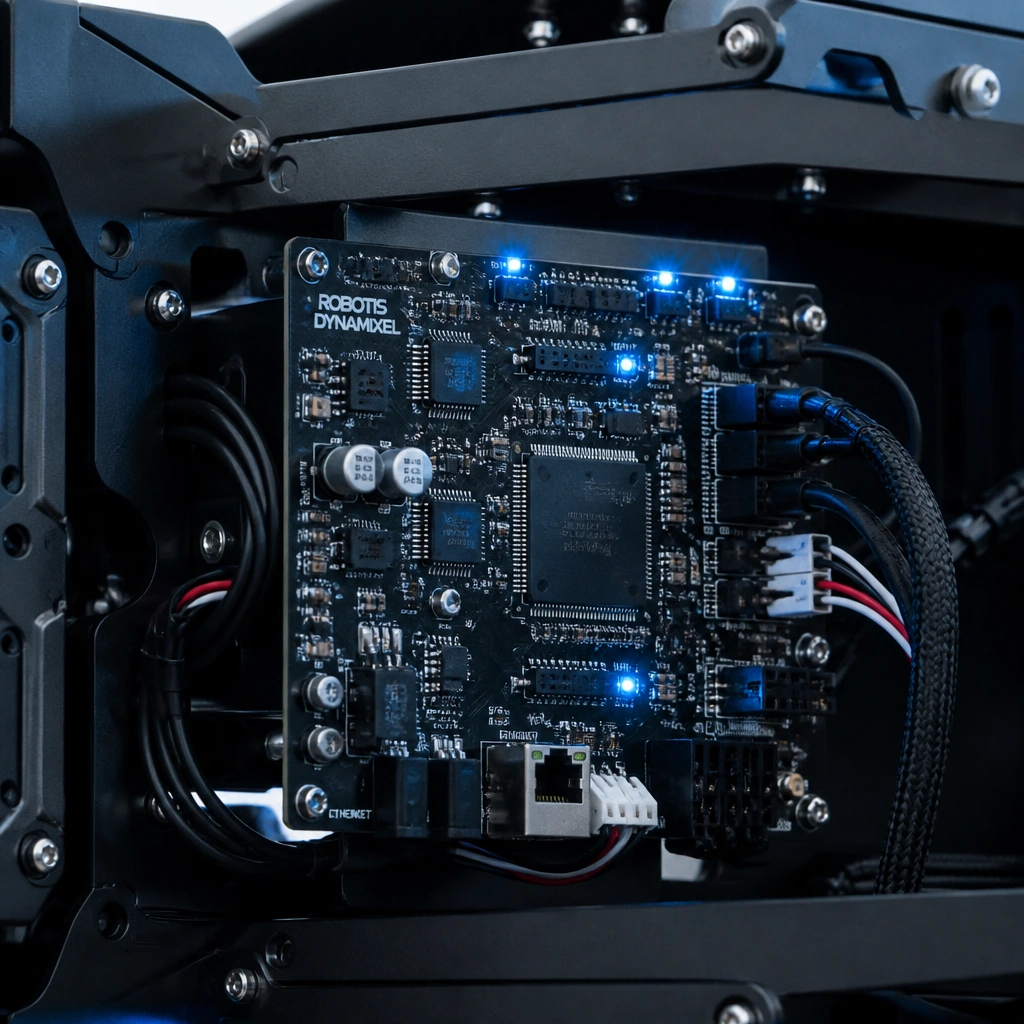
Engineers love the idea of infinite scalability in the cloud. It sounds clean. It sounds modern. But physics does not care about your scalable microservices architecture. When an autonomous forklift rolls down a crowded warehouse aisle, network jitter is the enemy. Data has to stay local. Processing must happen on the metal sitting right inside the chassis.
Moving compute to the edge sounds simple until you touch the hardware. Power consumption dictates everything. You cannot strap a water-cooled server rack onto a delivery drone. Every watt burned by your accelerator chip drains the battery, shortening mission times and threatening operational viability.
Redefining Silicon Constraints
The race is no longer about raw FLOPS alone. It is about efficiency per watt. Modern robotic engineering demands domain-specific architectures—NPUs, FPGAs, and custom ASICs built specifically for sensor fusion. General-purpose CPUs are out. They simply choke under the sheer volume of spatial data coming from cameras, radar, and inertial measurement units.
- Low-power neural accelerators replacing bulky GPUs
- Radiation-hardened components for extreme industrial environments
- On-chip memory caching to eliminate bus-transfer bottlenecks
Stop designing for ideal network coverage. Build your robotic perception stack assuming total connectivity loss for at least thirty seconds at a time. If the robot cannot safely execute an emergency stop entirely offline, your architecture has failed.
The Shifting Architecture Stack
Let's look at how engineering teams are restructuring their software pipelines to handle edge constraints effectively. The old way of dumping raw sensor logs into a massive centralized database is dead.
| Aspect | Traditional Approach | Modern Solution |
|---|---|---|
| Data Routing | All raw feeds sent to cloud | Localized filtering and edge inference |
| Failure Recovery | Remote operator intervention | Autonomous fallback states and safe-harbor routing |
| Model Updates | Manual firmware flashing | Over-the-air delta weights pushed to localized nodes |
Orchestrating Fleet Intelligence at the Edge
Stand-alone autonomy is impressive. Fleet-wide coordination is where businesses actually make money. But coordinating fifty mobile robots without a continuous high-speed uplink requires a different mindset. Instead of acting as master controllers, the cloud becomes a synchronization layer rather than a real-time brain.
Nodes share lightweight map updates with each other via peer-to-peer mesh networking. If one robot maps an obstacle, that spatial vector propagates across the local fleet instantly. The cloud merely archives aggregated performance logs at the end of the shift. This decoupling is the true secret behind resilient autonomous operations.
Frequently Asked Questions
Does edge computing eliminate the need for cloud infrastructure entirely?
No. The cloud remains vital for heavy tasks like deep learning model training, global route optimization, and long-term fleet analytics. The shift is functional: execution moves to the edge, while long-term learning stays centralized.
How do we handle unexpected sensor failures on autonomous units?
Redundancy is mandatory. Modern engineering utilizes sensor cross-validation—combining lidar, optical cameras, and ultrasonic arrays—so that if one system degrades, the edge processor seamlessly shifts weight to alternate sensor streams without crashing.