- Optics First: Waveguide efficiency and brightness remain the primary engineering bottlenecks.
- AI Integration: On-device neural processing is replacing heavy external compute rigs for real-time tracking.
- Display Shifts: Micro-OLED and micro-LED panels are driving pixel density past human visual acuity limits.
Let us be candid: most hype cycles surrounding spatial computing ignore the grueling physics of pushing millions of pixels close to the human eye. Heavy headsets and dim optics used to dominate the conversation. Now, a quiet hardware shift is underway.
The Thermal Trap Behind Modern Headsets
Heat dissipation dictates everything in wearable computing. Pack too many transistors near a user's forehead, and thermal throttling ruins the experience within minutes. Engineers learned this the hard way.
Older designs relied on active fans, which added noise and bulk. Today's approach looks entirely different. Passive cooling channels, vapor chambers, and silicon designed specifically for low-power neural networks keep temperatures manageable.
- Silicon Specialization: Moving away from general-purpose chips to dedicated spatial co-processors.
- Voltage Scaling: Dynamic power delivery based on eye-tracking data and focal gaze.
- Material Science: Adopting magnesium-lithium alloys for ultra-light structural chassis.
Optics and the Waveguide Dilemma
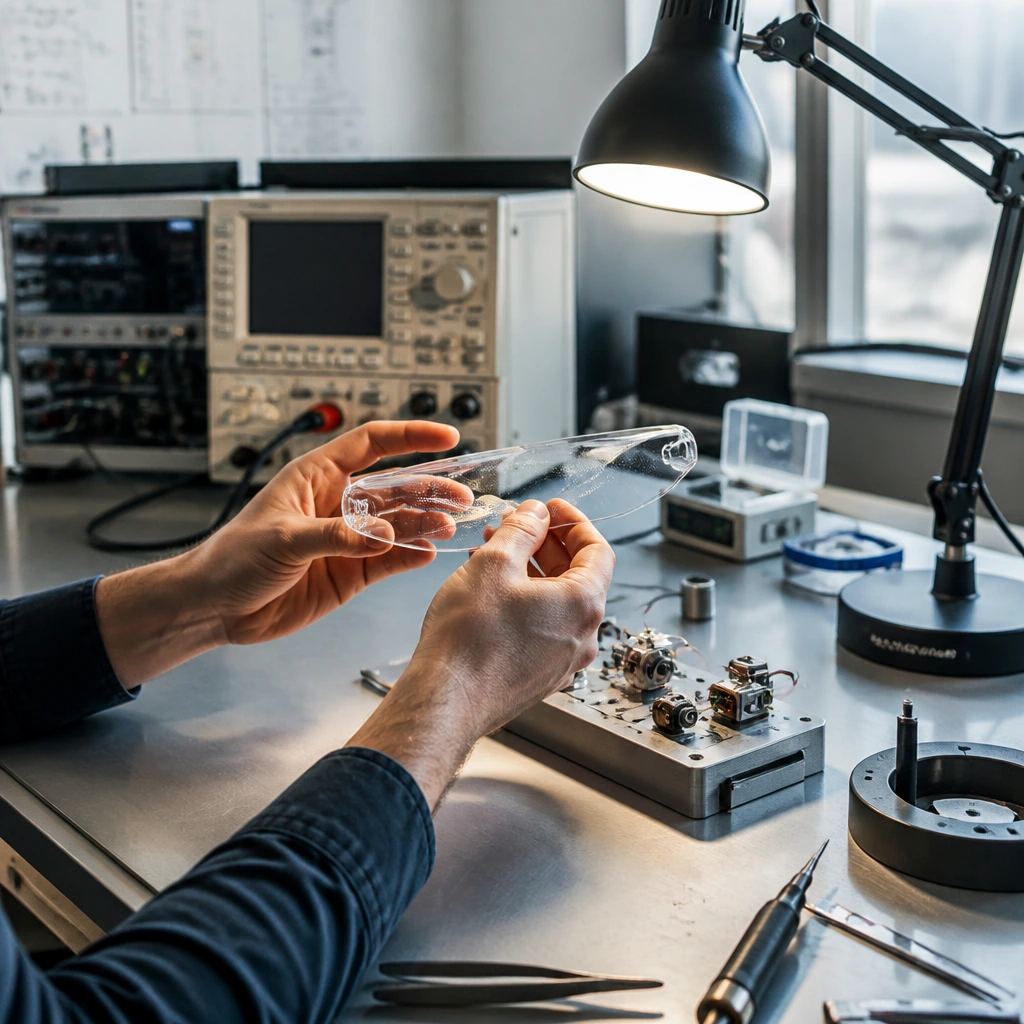
Light bending is stubborn physics. Getting bright, high-contrast imagery from a micro-display into the human retina without blinding the user with stray light requires extreme precision. Diffraction gratings etched into glass waveguides are improving, yet manufacturing yields remain low.
When you look through a pair of modern smart glasses, you are watching light bounce multiple times inside a microscopic sandwich of glass before hitting your pupil. Any tiny defect ruins the image uniformity.
Comparing Display Paradigms
| Aspect | Traditional Approach | Modern Solution |
|---|---|---|
| Display Tech | LCD / Standard OLED | Micro-LED & Micro-OLED |
| Brightness | Sub-1,000 nits | Exceeding 5,000 nits for outdoor visibility |
| Form Factor | Bulky ski-goggle design | Lightweight optical frames |
| Compute Load | Tethered processing units | On-chip localized AI acceleration |
The AI-Driven Sensor Fusion Shift
Raw hardware is useless without spatial awareness. Sensors must map rooms, track eye movements, and predict hand gestures at millisecond speeds. Here is what nobody tells you about sensor fusion: sensor drift ruins immersion faster than low resolution.
Never judge a spatial device by its marketing resolution specs. Evaluate the motion-to-photon latency. Anything above 15 milliseconds will trigger motion sickness in a significant percentage of users.
Modern architectures solve this by running lightweight computer vision models directly on the sensor node. Instead of sending raw video streams back and forth, the camera chip processes feature points locally, slashing latency drastically.
Power Management and Battery Realities
Batteries are heavy. Lithium-ion chemistry has hit a plateau, meaning runtime gains must come from aggressive power management rather than massive power cells. Every milliwatt matters when you are trying to squeeze eight hours of continuous use into a frame weighing less than seventy grams.
- Power Islands: Shutting down idle display sub-circuits when the user looks away.
- Adaptive Refresh: Dropping framerates during static reading tasks to conserve juice.
- Wireless Offloading: Shifting non-latency-critical background tasks to a paired smartphone.
Frequently Asked Questions
Why are micro-LED displays so difficult to mass-produce?
Transferring millions of microscopic inorganic LEDs onto a single backplane substrate with near-zero defect rates pushes current semiconductor fabrication equipment to its absolute physical limits.
Will standalone AR glasses replace smartphones anytime soon?
Not yet. While indoor productivity use cases are maturing, thermal limits, battery density, and outdoor optical brightness still lag behind what consumers expect from a pocket device.