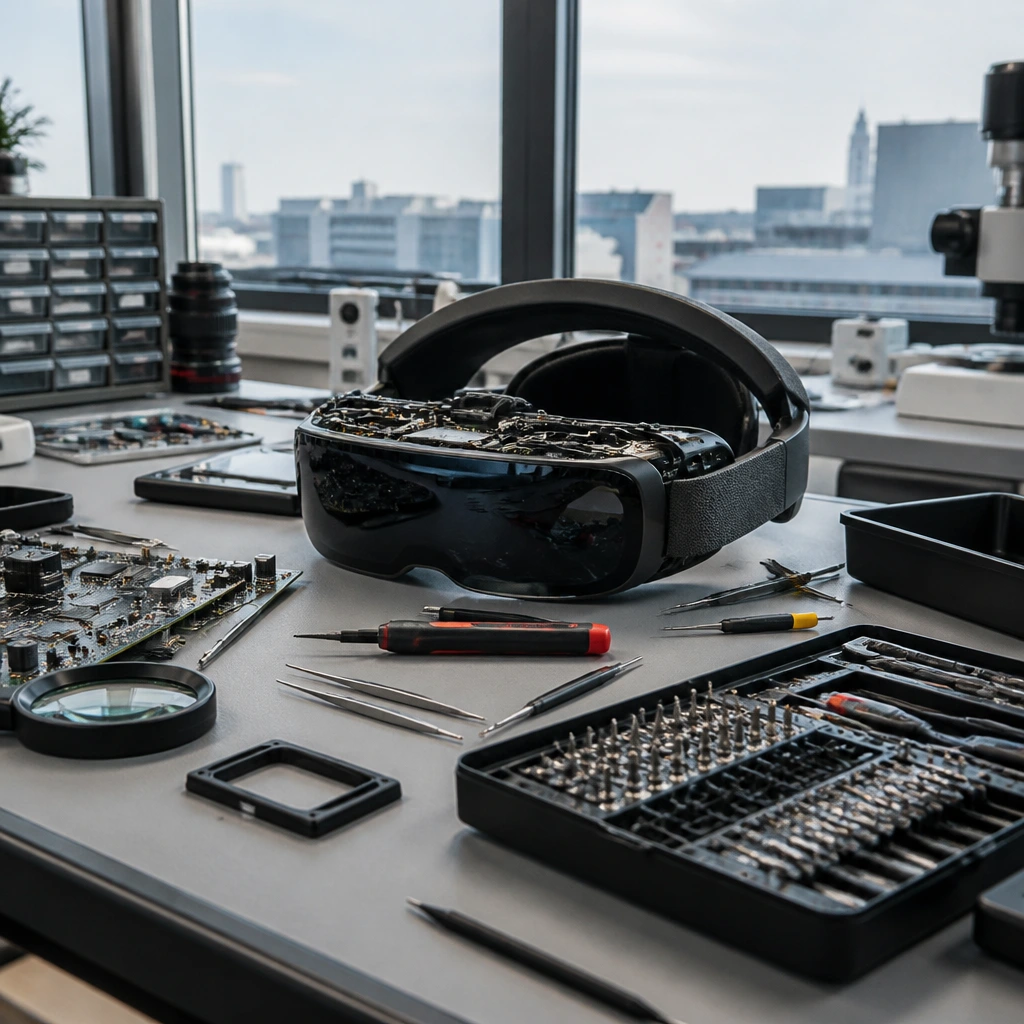
- Hardware Reality: Form factor constraints dictate thermal limits long before software optimization even begins.
- AI Integration: Machine vision models running at the edge are the true engines powering modern augmented reality.
- Display Physics: Waveguides and micro-OLED panels demand an entirely new playbook for optical engineering.
Most product teams are building spatial computing applications using a 2010 mobile app playbook. That mistake is costing millions of dollars and shipping devices that make users physically ill. Let's be candid: shrinking a desktop interface into a floating window in a headset is not spatial design. It is bad design disguised as innovation.
The Silicon and Thermal Trap Nobody Talks About
Here is what the marketing brochures leave out. Pushing high-refresh-rate stereoscopic video while running spatial tracking algorithms creates a thermal nightmare. An adult male engineer working in a lab knows the pain of seeing a prototype throttle down its processing power after just twelve minutes of continuous use.
You cannot cheat thermodynamics. Heavy compute workloads require active cooling or massive surface area, neither of which fit comfortably on a user's face. Hardware architects must rethink how silicon is packaged and distributed across the chassis. Edge AI processing helps offload some burdens, but local compute remains brutally demanding.
- Design for thermal dissipation before drafting final ergonomic casings.
- Prioritize dedicated neural processing units for spatial tracking to save battery.
- Accept that heavy continuous usage requires tethered compute or distributed power banks.
Optics, Waveguides, and the Physics of Light
Building a compelling augmented reality display requires bending light in ways that defy intuitive engineering. Glass optics, diffraction gratings, and field-of-view trade-offs create constant friction. If you push for a wider field of view, your weight balance shifts forward. If you optimize for weight, your brightness suffers under direct sunlight.
Micro-OLED panels have changed the resolution game entirely, but driving them efficiently without burning through power remains a massive hurdle. Engineers are forced to balance brightness, contrast, and thermal output in a package that weighs less than a standard pair of winter glasses.
| Aspect | Traditional Approach | Modern Solution |
|---|---|---|
| Display Panels | Standard LCD/OLED | High-density Micro-OLED |
| Optics | Refractive glass lenses | Diffractive waveguides |
| Tracking | External infrared cameras | On-device sensor fusion AI |
The AI Layer That Makes Spatial Computing Work
Sensors mean nothing without interpretation. Real-time semantic understanding of the physical environment separates a clunky gimmick from a truly useful tool. Artificial intelligence models must map room geometry, recognize dynamic objects, and predict hand gestures with near-zero latency.
This requires moving heavy inference models directly to the edge. Cloud round-trips introduce milliseconds of lag, and milliseconds are the exact difference between a natural interaction and instant motion sickness. Localized transformer models running on custom silicon are mandatory for tracking stability.
How to Stop Building Expensive Paperweights
Stop chasing feature lists. Focus instead on physical ergonomics and task-specific utility. If your target user has to take the device off every twenty minutes to rest their eyes or neck, your project has already failed.
Test your software prototypes on low-end target hardware first. If your interface runs smoothly on constrained silicon, scaling up to premium devices is easy. Doing the reverse guarantees massive performance debt.
Engineering teams need to collaborate closely with industrial designers from day one. Software features cannot save a poorly balanced chassis, and sleek aesthetics cannot excuse a thermal shutdown loop.
Frequently Asked Questions
Why is latency such a difficult problem to solve in augmented reality?
Human vestibular systems notice micro-delays instantly. When visual movement lags behind physical head rotation by even twenty milliseconds, the brain registers it as poison, triggering motion sickness.
Are standalone headsets replacing tethered systems anytime soon?
Not for high-fidelity industrial applications. While standalone units excel at mobility, heavy engineering workloads still demand the raw compute power delivered via tethered connections.