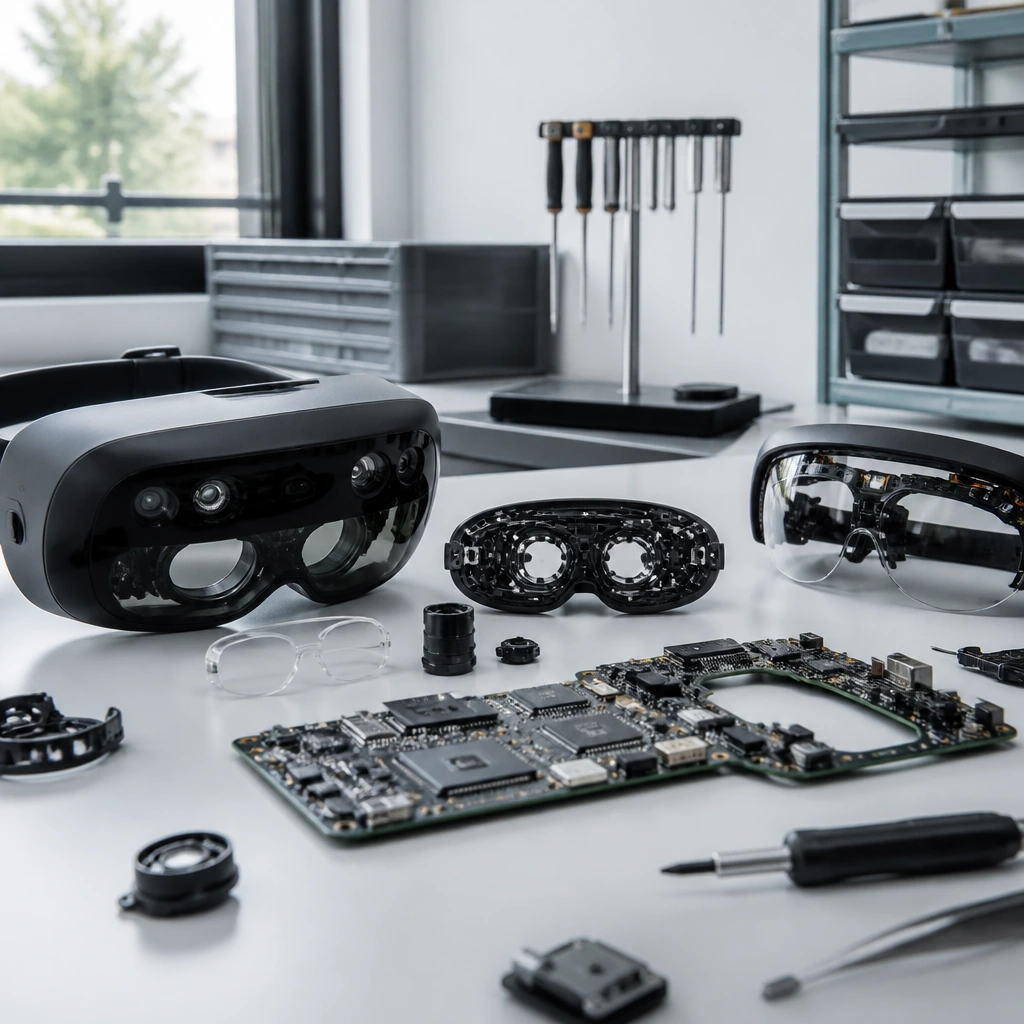
- Neural Pipelines: Machine learning is taking over raw rasterization pipelines at the edge.
- Thermal Realities: Optics and thermal dissipation dictate form factor limits, not silicon power.
- Display Physics: Micro-OLED and waveguide efficiencies demand entirely new driver electronics.
Most engineering teams building spatial hardware are solving the wrong problems. They obsess over pixel density while their thermal budgets cook the user's forehead. Let's be candid: raw compute specs mean nothing if the optical stack cannot deliver stable focal planes without inducing nausea. The rules of display engineering have fundamentally shifted.
The Thermal Trap Destroying Hardware Roadmaps
Here is what nobody tells you about modern augmented reality hardware: thermal throttling is the silent killer of immersive experiences. You can stack all the neural processing units you want onto a board, but if heat has nowhere to go, your brilliant 90-hertz display drops frames within ninety seconds.
Engineering leaders constantly chase higher nits without accounting for passive dissipation limits. Fans are dead on arrival for face-worn devices. Liquid cooling adds unacceptable weight. The solution requires a brutal redesign of how data moves from the SOC to the display panel.
- Strip unnecessary compute layers off the edge device and offload to localized hubs.
- Redesign display drivers to switch off idle subpixels dynamically.
- Prioritize thermal mass distribution over raw industrial design aesthetics.
Why Traditional Rasterization Is Dead in Spatial Computing
For decades, graphics pipelines relied on flat screens and predictable pixel grids. Spatial computing shatters that comfort zone entirely. When rendering virtual objects anchored to a physical living room, depth perception requires real-time ray tracing paired with predictive eye-tracking models.
We are watching the rapid decline of standard rasterization engines. Machine learning now dictates how pixels populate the user's field of view. Foveated rendering is no longer a fancy trick; it is mandatory infrastructure.
| Aspect | Traditional Approach | Modern Solution |
|---|---|---|
| Rendering | Full-screen rasterization | Dynamic foveated neural rendering |
| Optics | Plastic Fresnel lenses | Custom multi-element glass waveguides |
| Latency | Sub-20 millisecond targets | Predictive motion-to-photon under 8ms |
The Optics Problem Nobody Wants to Solve
Glass is heavy. Plastic scratches. Waveguides leak light and destroy contrast ratios in bright sunlight. Every optical engineer knows these trade-offs, yet executive leadership keeps promising lightweight sunglasses that pack cinematic FOV.
Physics refuses to negotiate. If you want a wide field of view, your optical engine grows thicker and heavier. Bending light through micro-structured surfaces introduces chromatic aberration that demands massive computational overhead to correct.
Stop waiting for an optical miracle. Build your software architecture assuming your current waveguide has a 35-degree effective sweet spot, and optimize your user experience around that constraint.
Software and Hardware Co-Design: The Only Way Forward
Siloed engineering departments are destroying product launches. The software team writes rendering shaders without understanding the physical limitations of the display controller. Meanwhile, the hardware team orders off-the-shelf micro-OLED panels that lack the necessary refresh granularity.
True spatial computing demands simultaneous co-design. Every line of inference code must align with the physical gate structure of the display driver. When hardware and software speak the same dialect from day one, battery life doubles and latency vanishes.
Frequently Asked Questions
Why are micro-OLED displays so difficult to source at scale?
Manufacturing silicon-based OLED panels requires semiconductor fabrication standards rather than traditional glass line processes. Yield rates remain stubbornly low because a single dust particle ruins millions of microscopic pixels.
Is eye-tracking hardware mandatory for spatial computing?
Without reliable eye-tracking, foveated rendering is impossible, which means your thermal and battery budgets will collapse under the weight of full-resolution rendering.