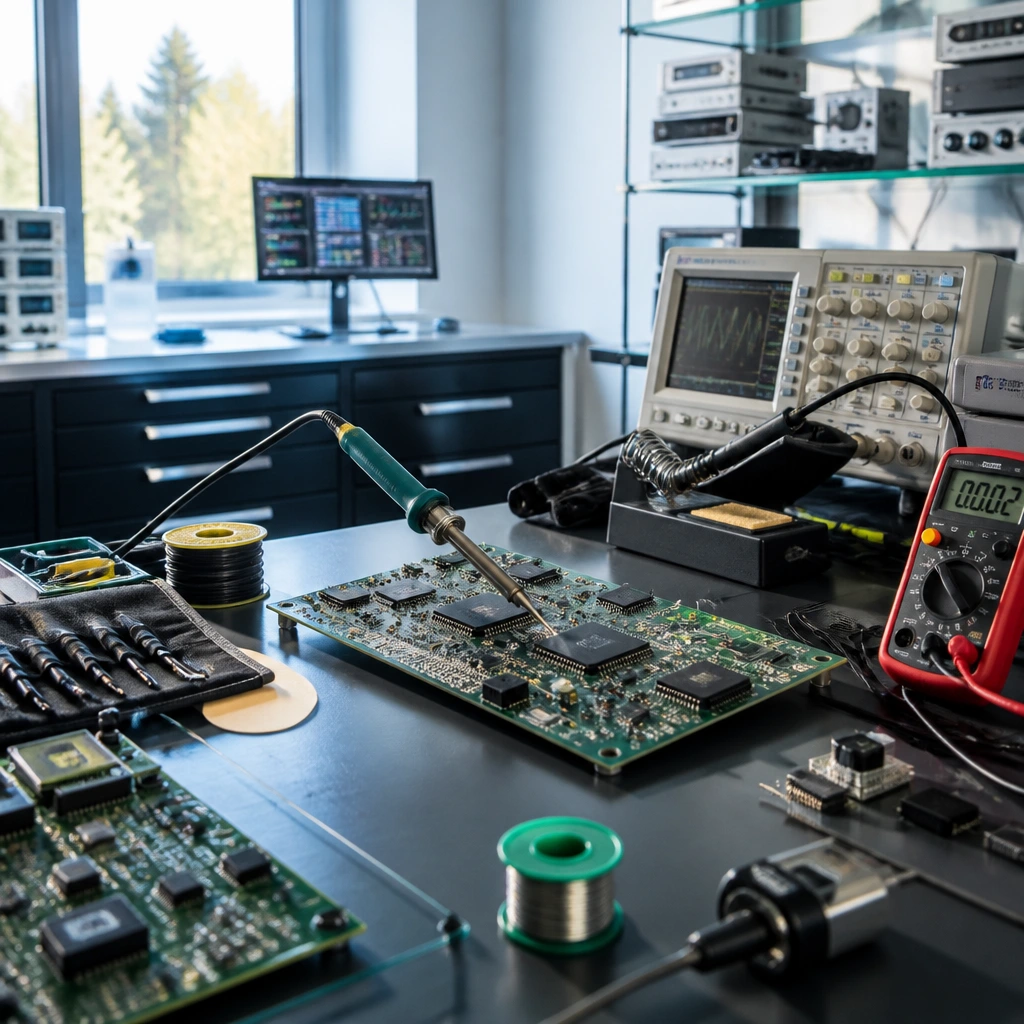
- Edge AI Overhaul: Cloud dependency is quietly draining hardware budgets and introducing unacceptable latency.
- Silicon Shift: Low-power neural processing units (NPUs) are replacing traditional microcontrollers for local intelligence.
- Security Realities: Hardware-level roots of trust are no longer optional for industrial deployments.
Your smart thermostat just choked on a basic firmware update. Again. Let's be candid: we built an entire generation of connected hardware based on a broken premise. We assumed stable bandwidth, infinite cloud computing, and forgiving power grids. Reality hit hard. Devices sit in dark basements, remote fields, and factory floors where connectivity drops daily. Here is what nobody tells you about the current hardware cycle: the cloud-first era of embedded systems is officially over.
The Edge Intelligence Reckoning
For years, product teams rushed to wire every sensor to distant AWS servers. It sounded neat in slide decks. Send raw temperature readings, crunch algorithms in the cloud, and ship the result back. Simple. But simple breaks down at scale.
Bandwidth costs pile up fast. Privacy regulations slam the door on raw data streaming. Worst of all, latency kills user experience. If an industrial robotic arm waits half a second for a cloud round-trip to detect an anomaly, a multi-million-dollar machine breaks. Local inference is the only logical path forward.
- Bandwidth Independence: Processing data locally keeps cellular data bills from bankrupting the business model.
- Sub-Millisecond Response: Local neural networks react instantly to critical triggers without routing packets through external servers.
- Enhanced Privacy: Sensitive biometric or industrial telemetry never leaves the physical perimeter of the device.
Silicon Architecture Reborn
Look inside the latest generation of smart devices. You will not find standard ARM Cortex-M chips running basic bare-metal C code. Instead, specialized embedded micro-NPUs are stealing the spotlight.
Silicon vendors finally stopped cramming desktop GPUs into toaster ovens. They designed custom architectures built explicitly for tiny machine learning workloads. Quantized models run on mere milliwatts. This changes everything for battery-powered environmental monitors and wearable health trackers.
The Battleground of Device Security
Software patches cannot fix a fundamentally flawed silicon layout. Hackers understand this. They attack physical endpoints, extracting keys from flash memory using cheap voltage glitching tools.
Enterprise buyers now demand hardware-level root of trust from day one. Secure elements must live directly on the printed circuit board. If the hardware cannot verify its own boot sequence, nobody will buy it. Period.
Do not wait for your software team to beg for hardware security modules. Mandate physical unclonable functions (PUF) in your RFP specs today, or watch your entire product line get recalled after a basic side-channel attack.
Comparing the Old Playbook to Modern Realities
| Aspect | Traditional Approach | Modern Solution |
|---|---|---|
| Data Processing | Cloud-centric aggregation | Edge AI and local inference |
| Power Management | Always-on active states | Event-driven duty cycling |
| Security Layer | Software-only encryption | Hardware root of trust |
The Cost of Getting This Wrong
Technical debt in embedded systems hurts more than web app debt. You cannot simply push a hotfix to a sensor deployed on a wind turbine in the North Sea. Hardware recalls cost fortunes. Reputation damage lasts for years. Engineers who design for resilience from the silicon up are the ones winning market share right now.
Frequently Asked Questions
Why shift intelligence to the edge if cloud computing is so cheap?
Cloud compute is only cheap when data volumes are low. Once you scale to tens of thousands of continuous sensors, bandwidth and storage fees explode. Edge AI eliminates redundant transmissions.
Are low-power NPUs powerful enough for complex tasks?
They are not training giant language models locally. However, through aggressive quantization and pruning, they handle anomaly detection, voice recognition, and computer vision exceptionally well.